Unique XL Kinetic Art object by Henk Gosses “Gosses FFX”
Unique XL kinetic art object by Henk Gosses – “Gosses FFX”
A very large, interactive kinetic machine full of light, movement, sound and unexpected effects.
Henk Gosses made the Dreammachine – GOSSES FFX in 2001 for the 73rd lustrum (five-yearly anniversary) of Utrecht University.
Visitors could leave questions in the machine, press buttons and set mechanisms in motion, and were surprised by bells, horns, flashing beacons, moving parts and even water, among other things. The original completed lustrum cards are still with the work.
We bought the installation in 2015 from the storage of Utrecht University. After standing idle for many years, the machine has been checked and made to work again.
An exceptionally large work by an artist who exhibited his machines as fine art at Museum De Lakenhal as early as 1978, later built robots, worked with Chriet Titulaer and made the famous mechanical objects for the Postbank commercials.
Dimensions: 150 cm wide, 88 cm deep and 200 cm high.
The Dreammachine is now available for sale.
Anyone who sees only a strange technical object is missing half the story. Read on, and you will discover why Henk Gosses and his machines are so strikingly relevant again right now.
Henk Gosses – the artist who brought machines to life
Artist, inventor, robot builder and maker of machines unlike anything else.
A robot hand that fetches a beer from the fridge. A vacuum cleaner that seems to have a life of its own. A mechanical dachshund for the Postbank. Robots made of tin, gears and old toy parts. Machines that move, smoke, blink, make noise and sometimes seem to exist mainly because Henk Gosses wanted to know whether he could bring them to life.
And then there is a construction several metres in size, full of motors, lamps, pipes, rotating parts and technical absurdism: the Gosses FFX.
Describing Henk Gosses merely as a robot builder does him an injustice.
He was first and foremost a visual artist.
An artist who simply preferred working with motors, gears, electronics and found parts to paint and canvas.
Machines as art
Hendrik Izaak Gosses was born in Leiden on 10 September 1947 and died on 14 May 2006.
In art-historical documentation he is referred to as a sculptor. That is significant, because he later became known mainly as a robot collector, inventor and builder of extraordinary machines.
But his roots lay firmly in the visual arts.
As early as 1978, when Gosses was thirty years old, he was given an exhibition at Museum De Lakenhal in Leiden under the telling title:
Henk Gosses: machines
The exhibition ran from 20 January to 6 March 1978.
From early on, then, his machines were presented not as technical curiosities but as works of art.
The exhibition was also accompanied by a publication by Hans Sizoo: Henk Gosses (desolation products), Folly Klomp. A copy is now held in the Research Library of the Rijksmuseum.
That may well be the best starting point for understanding his entire oeuvre.
Gosses made machines.
But he made them as an artist.
Machines without necessary purpose
Gosses did not build machines because the world urgently needed a more efficient way to fetch a beer from the fridge.
Quite the opposite.
His constructions were allowed to be complicated, absurd, funny, theatrical and utterly impractical.
For him, technology was not an end in itself.
It was material.
Just as a sculptor uses clay, stone or bronze, Gosses used electric motors, gears, switches, pipes, lamps, springs, tin, old parts and electronics.
From these came objects somewhere between sculpture, machine, automaton, robot and character.
His machines did something.
They moved.
They made noise.
They smoked.
They blinked.
And sometimes they almost seemed to have a mood of their own.
That is where much of his humour lies.
A Gosses machine often appears to be terribly busy with something important, while at the same time you wonder what on earth the thing is actually doing.
From machines to robots
His fascination with robots became increasingly important over the course of his life.
Gosses collected old robots and space toys, especially the fantastic mechanical toys from Japan of the 1950s and 1960s.
But collecting alone was not enough.
He modified existing robots, combined parts and built new creations.
Sometimes he made not only the robot itself, but also the packaging, name and graphic identity.
This makes it hard to see his robots simply as toys.
They are sculptures.
Assemblages.
Small fictional machines from a world that existed only for Gosses.
Gustav
One of his best-known creations is the Gustav Robot.
Gosses made Gustav in a small edition of just 25 pieces.
A documented example, number 12/25, even still has the original box made by Gosses.
An edition of 25 is actually exceptional rather than normal within his oeuvre. In the international robot-collecting world, many of Gosses’s other creations are described as one-offs.
He did not work as a toy manufacturer.
He worked as a maker.
Every object could turn out differently.
The Giant Motor Robot
Another impressive example is his Giant Motor Robot.
Gosses used an existing robot as a starting point, but changed it so radically that an entirely new object emerged.
The robot was given new mechanics and functions and could walk, move, light up, produce sound and make smoke, among other things.
The packaging also became part of the whole.
That is typical of his way of working.
He looked at an existing object and apparently saw not what it was, but what it could still become.
Robots in the museum and in a book
In 1986 Gosses published Het Robotboek (The Robot Book) together with Chriet Titulaer, with the publisher A.W. Bruna.
Titulaer was one of the best-known storytellers about science, technology and the future in the Netherlands.
The combination with Gosses was actually logical.
Titulaer talked about the future.
Gosses built it.
In the same year, from 29 March to 3 May, the Rotterdam Municipal Library hosted an exhibition entitled:
Robots by Henk Gosses.
The line of his development is thus clear.
In 1978 he exhibited machines.
In 1986 he exhibited robots.
But in fact the subject hardly changed.
It remained about the boundary between human, technology, fantasy and movement.
The Postbank machines
And then his machines suddenly found their way into millions of Dutch living rooms.
Gosses also worked on advertising productions and built various bizarre mechanical devices for the well-known Postbank commercials around ‘makkelijk’ and ‘lekker makkelijk’ (‘easy’ and ‘nice and easy’).
There he could really let himself go.
The machines had to actually work in front of the camera, but at the same time they were allowed to be absurd.
Among other things, he built the contraption in which a mechanical hand fetches a beer from the fridge.
He made the wondrous vacuum cleaner.
An automatic shopping bag.
A hairdressing machine.
A driving doormat.
And various other mechanical devices from the campaign.
And then, of course, there was the famous:
robot dachshund
A mechanical dog that looks as if someone had put a dachshund, a robot and a science-fiction film into one machine.
It is almost impossible to imagine an object that is more Henk Gosses.
Technology and humour are completely interwoven in it.
Today part of such a commercial could be made digitally.
Gosses had to actually build it.
The motor had to run.
The leg had to move.
The arm really had to grab the beer.
The vacuum cleaner really had to behave the way the director wanted.
That is precisely why this commercial work is surprisingly close to his autonomous art.
The client was different.
But the maker was the same.
Art or special effect?
With Gosses, that distinction actually seems to vanish constantly.
He could make a machine for a museum.
A robot for himself.
An object for a television commercial.
Or technical effects for an attraction.
For a large project at Center Parcs Port Zélande, for example, he worked on special effects and show control.
There too it came down to the same question:
how do you make dead material behave as if it were alive?
That may well have been his true speciality.
Not robots.
Not advertising.
Not technology.
But machines with a soul.
Henk Gosses on television
Gosses also appeared on television himself.
In a 1989 broadcast he was interviewed as Robotman.
In a BNN broadcast of 27 December 2000, Bridget Maasland visited him. Strikingly, the official description by Beeld & Geluid (the Netherlands Institute for Sound and Vision) refers to him as:
‘inventor Henk Gosses’.
It says a lot about how differently people saw him.
To the museum he was a sculptor.
To robot collectors he was a robot builder.
To television he was an inventor.
To clients he was someone who could actually make impossible machines work.
All of those descriptions are probably correct.
But none of them is complete.
His own world on film
Fortunately, films have also survived in which the world of Henk Gosses can be seen in detail.
The three-part series Robot Collector Henk Gosses’s Home Movie is particularly valuable.
It shows not only his collection of robots.
You see his machines, his own creations and various constructions he made for commercial productions.
The machines from the Postbank commercials also appear in it.
These films show how little separation there was for Gosses between collecting, making art, technology and daily life.
It all seems to be part of one big world.
A world full of robots and machines.
An artist who suddenly feels highly relevant again
And something curious is happening today.
When Gosses built his robots and mechanical helpers, autonomous machines, household robots and artificial assistants still largely belonged to the world of science fiction and futuristic fantasy.
Not any more.
Robots are actually being developed to take over human tasks in factories, businesses and eventually homes. Artificial intelligence is being linked to moving machines that can perceive their surroundings, understand instructions and act ever more independently.
This makes Gosses’s work feel surprisingly relevant all of a sudden.
Not because he invented today’s AI robot.
He did not.
And technically his machines are of course completely different from the robots of today.
But the vision of the future he played with is becoming reality.
A mechanical arm that jokingly fetches a beer from the fridge in a Postbank commercial was absurdist theatre at the time.
Now technology companies are trying to teach robots exactly these kinds of everyday actions.
In hindsight the joke takes on something almost visionary.
But this is precisely where his artistry remains essential.
Gosses was not trying to build the most efficient robot of the future.
As an artist, he explored what happens when machines begin to feel more and more human or animal.
When a machine gets arms.
Or eyes.
Or a character.
When technology is not just a tool, but a presence.
These are questions that may be more relevant now than ever.
And so today we look at his work differently than we did twenty or thirty years ago.
Not only as something funny or futuristic.
But also as an artistic vision of a world that has slowly become reality.
International cult status
Although Henk Gosses largely disappeared from view in the Netherlands after his death, outside a relatively small circle, something different happened internationally.
In the world of robot and space-toy collectors he was not forgotten.
His creations are still recognised, collected, restored and discussed.
After his death, a large memorial thread appeared on the international robot forum Alphadrome, in which friends and collectors wrote about him.
His work still turns up with specialist collectors.
Ten years after his death, a new robot was even built as a tribute to him: the Gosstavo.
It used parts that came from Gosses’s estate.
That perhaps says more about his influence than any auction record.
Other makers recognised in him someone with a completely personal language.
The Gosses FFX
And that brings us to the work that led us to delve into Henk Gosses again ourselves.
Our collection includes an exceptionally large kinetic work by his hand:
GOSSES FFX
The machine was made in 2001 for the 73rd lustrum of Utrecht University, which celebrated its 365th anniversary that year.
When we bought the machine, it came with an A4 sheet of information about the object, which mentioned, among other things, the name Gosses FFX, Henk Gosses Dreammachine and its connection with the Utrecht lustrum.
Unfortunately we later lost that sheet of paper; we are still looking for it…
Fortunately, much of its history turned out to have been literally preserved in the machine itself.
A machine full of questions
The Gosses FFX still comes with dozens of original completed question cards from the Utrecht University lustrum.
The cards show the campaign around 365 years of Utrecht University and the 2001 Knowledge Festival.
Visitors were invited to put a question to the university and its scientists.
And that question could actually be posted into the machine.
The Gosses FFX contains a letterbox into which the completed cards fell.
But as almost nothing with Henk Gosses had to work in a normal way, emptying that letterbox also became part of the object.
The compartment where the cards end up can be reached via a teapot in the installation.
It is one of those details that reveal his whole way of thinking.
Functional.
Technical.
Absurd.
And funny.
This made the Gosses FFX much more than a large kinetic sculpture or an unusual letterbox.
The visitor became part of the work.
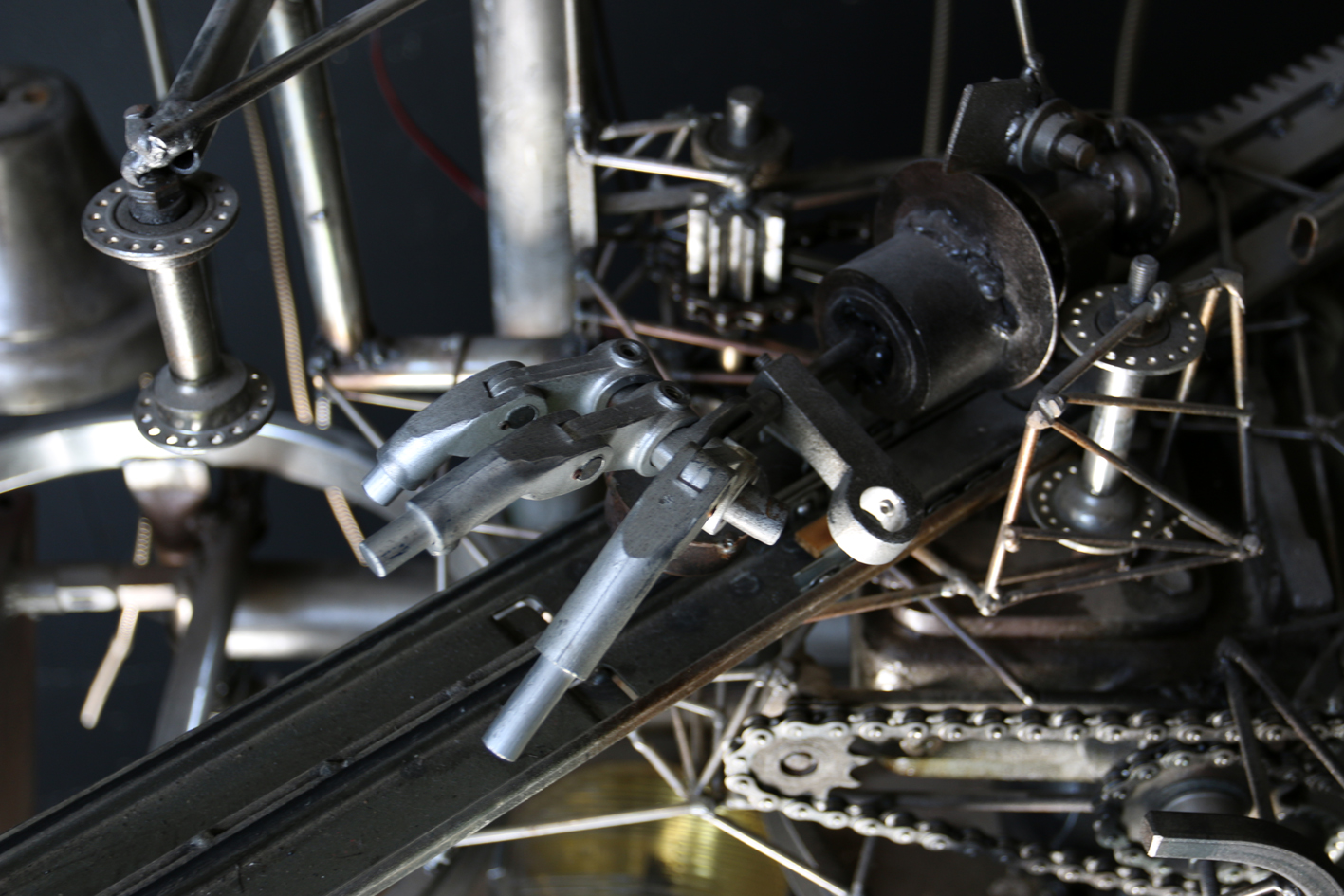
The machine has a control panel with a row of push buttons. Behind different buttons lies a different response: a bell, a car horn, a hooter, fog lights, headlights, flashing beacons and lighting around the letterbox. And if you are unlucky, you may even get sprayed with water.
Mechanically too, there is plenty to operate. With a lever, a whole system of gears can be set in motion, which ultimately makes a kind of arm with a hand move. Elsewhere in the construction, metal wires or rods come to life as soon as the machine is activated.
What is special is that not every button immediately reveals what it does. Some functions we have been able to reconstruct; others not yet. It is possible that part of the controls still activate functions we have not found. But it may just as well be that Gosses deliberately added buttons with no predictable effect, so that the visitor never knew exactly when the machine would suddenly respond.
And that last possibility would suit him perfectly.
The Gosses FFX does not seem designed to be viewed calmly from a distance. You have to touch it. Press. Turn. Try. Wait.
Sometimes nothing happens.
And then suddenly a horn goes off somewhere, a beacon starts spinning, a mechanism starts moving, or you get a splash of water.
This turns the work almost into a game between human and machine.
The visitor operates the object, but is never entirely in control.
That unpredictable, almost mischievous character perhaps makes the installation one of the most complete examples of Gosses’s way of working: technology, movement, humour, surprise and absurdity all brought together in one machine.
From Utrecht University to our collection
After the lustrum, the machine disappeared from public view.
The enormous object ended up in storage within the Utrecht university / Parnassos environment.
It stayed there for years.
In 2015 we bought the Gosses FFX from that storage.
At the time, the documentation mentioned above and the original lustrum cards were still with the work.
We then published the machine on our website as early as 2017 under the name Gosses FFX, stating that Henk Gosses had made the work in 2001 for the 73rd lustrum of Utrecht University.
Then something happened that, in hindsight, is almost comical.
With us, too, the enormous machine disappeared into storage again.
And there it stood for roughly another eleven years.
Brought back to life
When we finally brought the Gosses FFX out again, it soon became clear that simply cleaning it and putting it on display was not really enough.
A Henk Gosses machine is meant to work.
My uncle Wim Verhoef, himself an inventor with a great deal of technical experience, therefore checked the entire installation.
He inspected the mechanism and made the machine work again.
And in doing so, something very fitting actually happened.
After standing still for years, a Henk Gosses machine came back to life.
Only then did it become fully clear what kind of object we had kept in storage all those years.
Because the Gosses FFX is impressive not only for its size or the enormous number of parts.
Its meaning lies precisely in what happens when it works.
Movement.
Light.
Mechanics.
Sound.
Interaction.
And that typical Gosses experience of feeling that a machine has an intention of its own.
Not a curiosity, but a late work
The more we delved into Henk Gosses, the less strange the Gosses FFX actually became.
This is not an isolated curiosity.
Not a gigantic technical joke that happened to be built by a robot collector.
It is a late kinetic work by a visual artist who exhibited machines as fine art at Museum De Lakenhal as early as 1978.
More than twenty years later, Gosses was still working with the same fundamental material:
machines,
movement,
wonder,
humour,
and the curious boundary between a technical object and something that almost seems alive.
Only by now the scale had become enormous.
The Gosses FFX also brings together different sides of his oeuvre.
The independent artist.
The constructor.
The maker of interactive machines.
The special-effects man.
The robot builder.
And the man who always managed to combine technical functionality with something absurd.
Even the teapot that gives access to the submitted questions belongs to that story.
Perhaps we have remembered Henk Gosses wrongly
In the end, that may be the most interesting thing about his history.
Henk Gosses is easily described as a robot collector, robot builder, inventor or special-effects man.
But in doing so we actually reverse his development.
He was a visual artist who chose machines as his material.
From that came robots.
Advertising objects.
Special effects.
Fantastic contraptions.
And ultimately a machine like the Gosses FFX.
His art was not really about robots.
It was about our fascination with machines.
About movement.
About imagination.
About technology that takes on something human.
And about the wondrous boundary between a lifeless object and something that, for just a moment, gives you the feeling that it is alive.
That makes his work not only interesting to look back on.
Precisely now that machines are genuinely becoming more and more autonomous, his oeuvre takes on new meaning.
Henk Gosses did not build the technology of our time.
He built his vision of the future.
And by now we have walked into that future.
Robot Collector Henk Gosses’s Home Movie – Part 1 https://www.youtube.com/watch?v=GGgMzHEb5PY
Robot Collector Henk Gosses’s Home Movie – Part 2 https://www.youtube.com/watch?v=hRcnZLLhwBI
Robot Collector Henk Gosses’s Home Movie – Part 3 https://www.youtube.com/watch?v=9gtnpGcH3_g
Henk Gosses – De Waarzegger / The Fortune Teller https://www.youtube.com/watch?v=LrhVu5E7DlA
The Auto Gyro Robot Car by Henk Gosses https://www.youtube.com/watch?v=wam2GRbwVX4
Robotman – Henk Gosses on television, 1989 https://www.youtube.com/watch?v=P2F3msThNT8
Watch Henk Gosses with Bridget Maasland at Beeld & Geluid
Henk Gosses appears from approx. 14:56.
Price:
€ 4.950
A question about this item?
Would you like to know more about this piece, the price, availability or shipping? Feel free to email us. We will see straight away which item your question is about.
Email us about this item →