Unique XL Kinetic Art object by Henk Gosses “Gosses FFX”
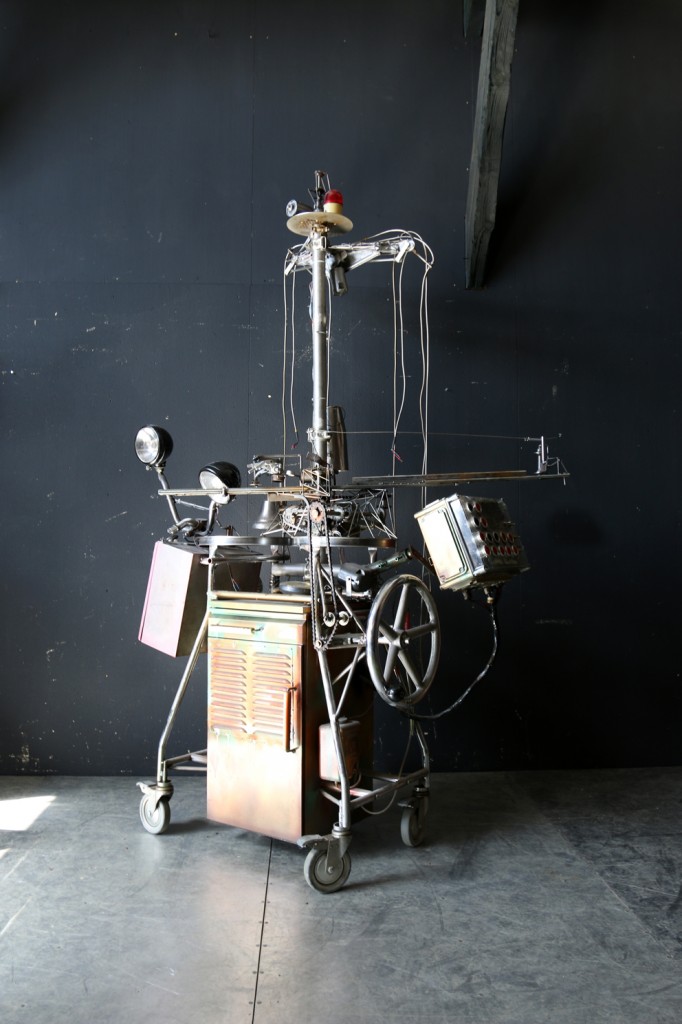
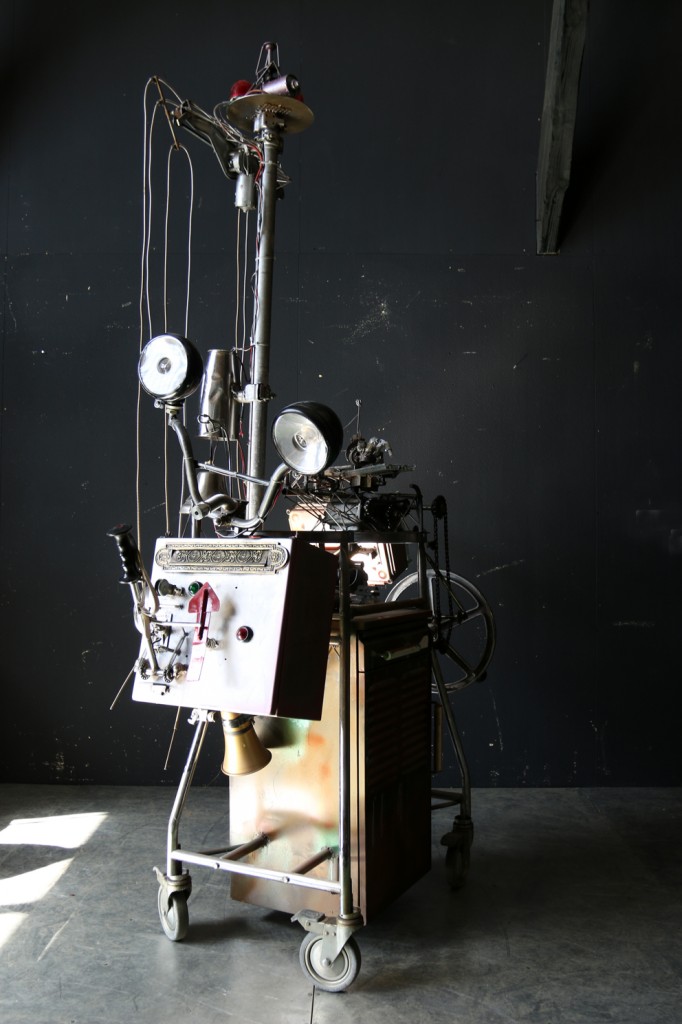
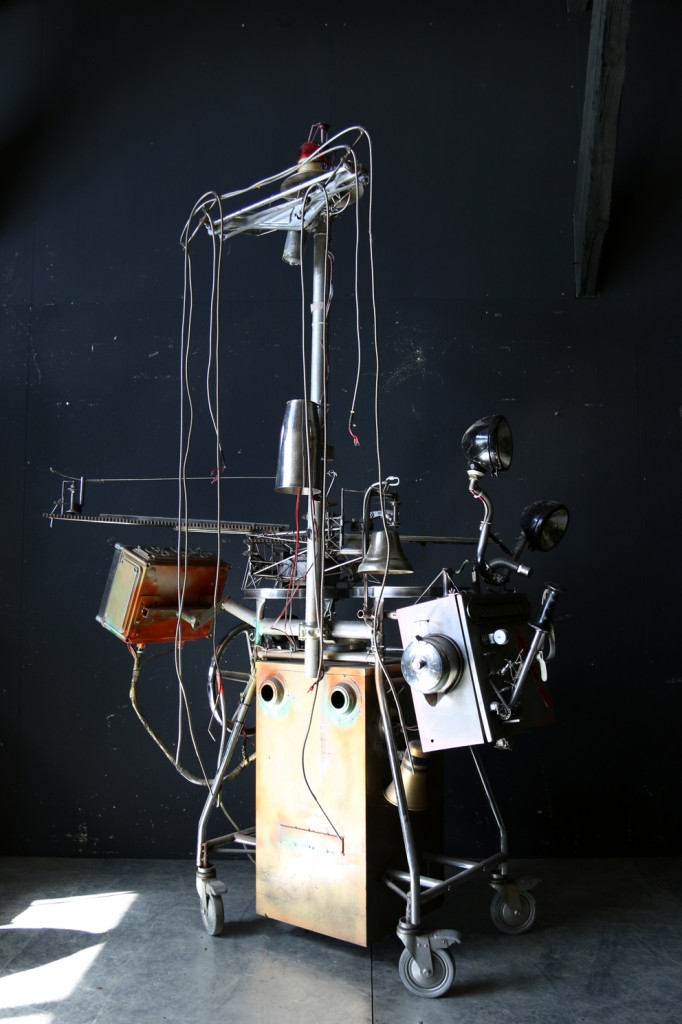
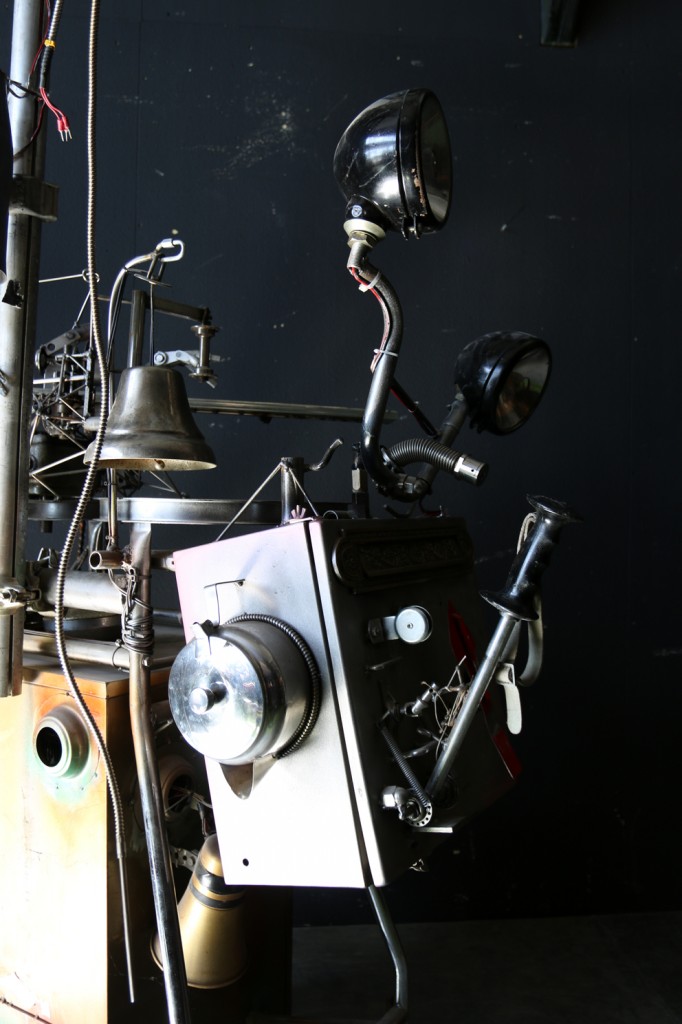

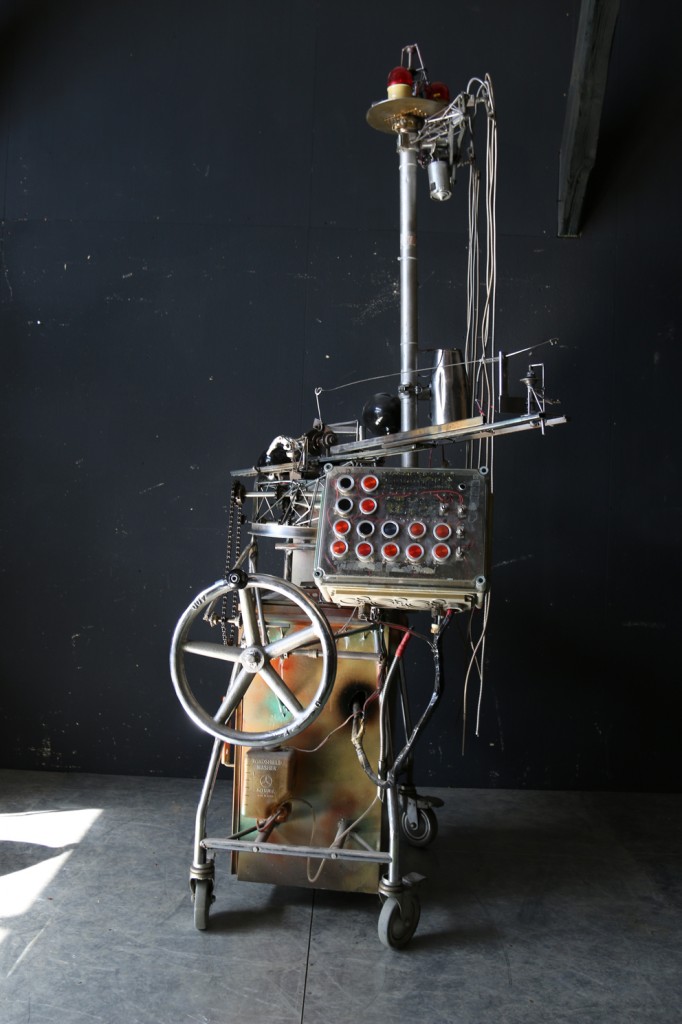
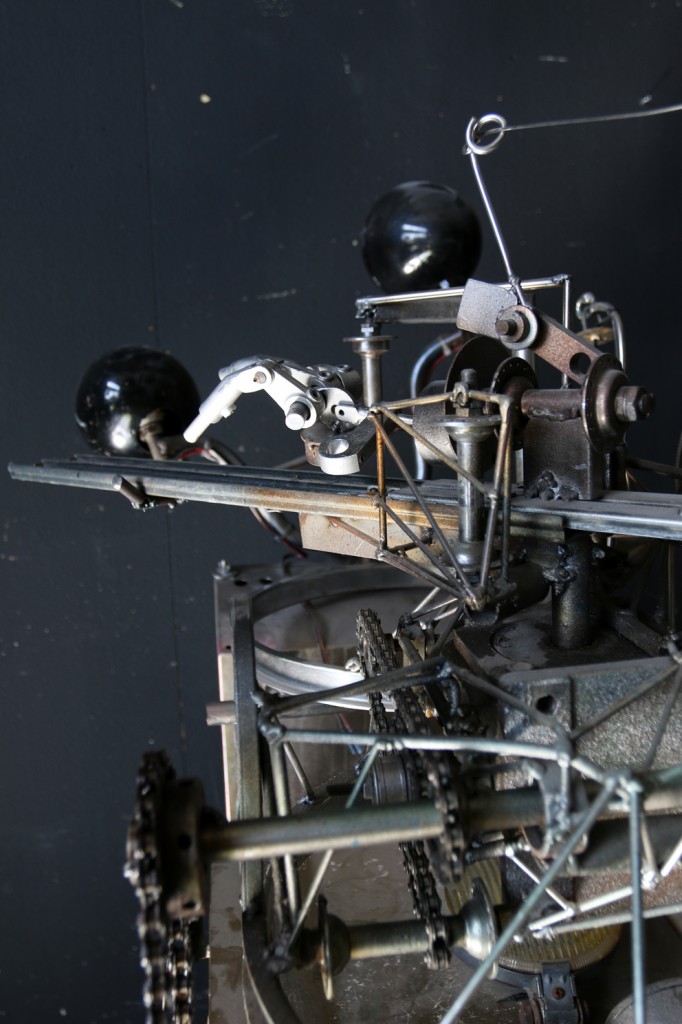

Een zeer grote, interactieve kinetische machine vol licht, beweging, geluid en onverwachte effecten.
Henk Gosses maakte de Dreammachine – GOSSES FFX in 2001 voor het 73e lustrum van de Universiteit Utrecht.
Bezoekers konden vragen in de machine achterlaten, knoppen bedienen, mechanismen in werking zetten en werden verrast door onder meer bellen, claxons, zwaailichten, bewegende onderdelen en zelfs water. De originele ingevulde lustrumkaarten zijn nog bij het werk aanwezig.
Wij kochten de installatie in 2015 uit de opslag van de Universiteit Utrecht. Na jarenlang stil te hebben gestaan is de machine nagekeken en opnieuw werkend gemaakt.
Een uitzonderlijk groot werk van een kunstenaar die al in 1978 zijn machines als beeldende kunst exposeerde in Museum De Lakenhal, later robots bouwde, samenwerkte met Chriet Titulaer en de beroemde mechanische objecten voor de Postbank-commercials maakte.
Afmetingen: 150 cm breed, 88 cm diep en 200 cm hoog.
De Dreammachine is nu beschikbaar voor verkoop.
Wie alleen een vreemd technisch object ziet, mist de helft van het verhaal. Wie verder leest, ontdekt waarom Henk Gosses en zijn machines juist nu opnieuw zo opvallend actueel zijn.
Henk Gosses – de kunstenaar die machines tot leven bracht
Kunstenaar, uitvinder, robotbouwer en maker van machines die nergens op leken
Een robothand die een biertje uit de koelkast haalt. Een stofzuiger die een eigen leven lijkt te leiden. Een mechanische teckel voor de Postbank. Robots van blik, tandwielen en oude speelgoedonderdelen. Machines die bewegen, roken, knipperen, geluid maken en soms vooral lijken te bestaan omdat Henk Gosses wilde weten of hij ze tot leven kon brengen.
En dan is er nog een metersgrote constructie vol motoren, lampen, leidingen, draaiende onderdelen en technisch absurdisme: de Gosses FFX.
Wie Henk Gosses alleen omschrijft als robotbouwer, doet hem tekort.
Hij was in de eerste plaats beeldend kunstenaar.
Een kunstenaar die toevallig liever werkte met motoren, tandwielen, elektronica en gevonden onderdelen dan met verf en doek.
Machines als kunst
Hendrik Izaak Gosses werd op 10 september 1947 in Leiden geboren en overleed op 14 mei 2006.
In de kunsthistorische documentatie wordt hij aangeduid als beeldhouwer. Dat is belangrijk, omdat hij later vooral bekend werd als robotverzamelaar, uitvinder en bouwer van bijzondere machines.
Maar zijn oorsprong lag nadrukkelijk in de beeldende kunst.
Al in 1978, toen Gosses dertig jaar oud was, kreeg hij in Museum De Lakenhal in Leiden een tentoonstelling onder de veelzeggende titel:
Henk Gosses: machines
De tentoonstelling liep van 20 januari tot en met 6 maart 1978.
Daarmee werden zijn machines al vroeg niet gepresenteerd als technische curiositeiten, maar als kunstwerken.
Bij de tentoonstelling verscheen bovendien een publicatie van Hans Sizoo: Henk Gosses (desolation products), Folly Klomp. Een exemplaar daarvan bevindt zich tegenwoordig in de Research Library van het Rijksmuseum.
Dat is misschien wel het beste vertrekpunt om zijn hele oeuvre te begrijpen.
Gosses maakte machines.
Maar hij maakte ze als kunstenaar.
Machines zonder noodzakelijk nut
Gosses bouwde geen machines omdat de wereld dringend behoefte had aan een efficiëntere manier om een biertje uit de koelkast te halen.
Juist het tegenovergestelde.
Zijn constructies mochten ingewikkeld, absurd, grappig, theatraal en volstrekt onpraktisch zijn.
Techniek was voor hem geen einddoel.
Het was materiaal.
Zoals een beeldhouwer klei, steen of brons gebruikt, gebruikte Gosses elektromotoren, tandwielen, schakelaars, leidingen, lampen, veren, blik, oude onderdelen en elektronica.
Daaruit ontstonden objecten die ergens tussen sculptuur, machine, automaat, robot en personage in zaten.
Zijn machines deden iets.
Ze bewogen.
Ze maakten geluid.
Ze rookten.
Ze knipperden.
En soms leken ze bijna een eigen humeur te hebben.
Daar zit ook veel van zijn humor.
Een machine van Gosses lijkt vaak ontzettend belangrijk bezig te zijn, terwijl je je tegelijkertijd afvraagt wat het ding in vredesnaam eigenlijk doet.
Van machines naar robots
Zijn fascinatie voor robots werd in de loop van zijn leven steeds belangrijker.
Gosses verzamelde oude robots en space toys, vooral het fantastische mechanische speelgoed uit Japan uit de jaren vijftig en zestig.
Maar verzamelen alleen was niet genoeg.
Hij veranderde bestaande robots, combineerde onderdelen en bouwde nieuwe creaties.
Soms maakte hij daarbij niet alleen de robot zelf, maar ook de verpakking, naam en grafische identiteit.
Daardoor wordt het moeilijk om zijn robots nog simpelweg als speelgoed te zien.
Het zijn sculpturen.
Assemblages.
Kleine fictieve machines uit een wereld die alleen bij Gosses bestond.
Gustav
Een van zijn bekendste creaties is de Gustav Robot.
Gosses maakte Gustav in een kleine oplage van slechts 25 exemplaren.
Een gedocumenteerd exemplaar, nummer 12/25, heeft zelfs nog de oorspronkelijke door Gosses gemaakte doos.
Dat er 25 exemplaren bestaan is voor zijn oeuvre eerder uitzonderlijk dan normaal. Binnen de internationale robotverzamelaarswereld wordt beschreven dat veel andere creaties van Gosses juist unica waren.
Hij werkte niet als speelgoedfabrikant.
Hij werkte als maker.
Ieder object kon weer anders worden.
De Giant Motor Robot
Een ander indrukwekkend voorbeeld is zijn Giant Motor Robot.
Gosses gebruikte daarvoor een bestaande robot als uitgangspunt, maar veranderde hem zo ingrijpend dat een compleet nieuw object ontstond.
De robot kreeg nieuwe mechaniek en functies en kon onder meer lopen, bewegen, licht geven, geluid produceren en rook maken.
Ook de verpakking werd onderdeel van het geheel.
Dat typeert zijn manier van werken.
Hij zag een bestaand voorwerp en zag daarin kennelijk niet wat het was, maar wat het nog zou kunnen worden.
Robots in het museum en in een boek
In 1986 publiceerde Gosses samen met Chriet Titulaer Het Robotboek bij uitgeverij A.W. Bruna.
Titulaer was in Nederland een van de bekendste vertellers over wetenschap, technologie en de toekomst.
De combinatie met Gosses was eigenlijk logisch.
Titulaer vertelde over de toekomst.
Gosses bouwde haar.
In hetzelfde jaar was in de Gemeentebibliotheek Rotterdam van 29 maart tot 3 mei een tentoonstelling te zien met de titel:
Robots van Henk Gosses.
De lijn in zijn ontwikkeling is daarmee duidelijk.
In 1978 exposeerde hij machines.
In 1986 exposeerde hij robots.
Maar eigenlijk veranderde het onderwerp nauwelijks.
Het bleef gaan over de grens tussen mens, techniek, fantasie en beweging.
De Postbank-machines
En toen kwamen zijn machines ineens in miljoenen Nederlandse huiskamers terecht.
Gosses werkte namelijk ook voor reclameproducties en bouwde verschillende bizarre mechanische apparaten voor de bekende Postbank-commercials rond ‘makkelijk’ en ‘lekker makkelijk’.
Daar kon hij zich volledig uitleven.
De machines moesten daadwerkelijk functioneren voor de camera, maar ze mochten tegelijk absurd zijn.
Zo bouwde hij onder andere de constructie waarbij een mechanische hand een biertje uit de koelkast haalt.
Hij maakte de wonderlijke stofzuiger.
Een automatische boodschappentas.
Een kappersmachine.
Een rijdende deurmat.
En verschillende andere mechanische apparaten uit de campagne.
En dan was er natuurlijk de beroemde:
robot-teckel
Een mechanische hond die eruitziet alsof iemand een teckel, een robot en een sciencefictionfilm in één machine heeft gestopt.
Het is bijna onmogelijk om een object te bedenken dat méér Henk Gosses is.
Techniek en humor zitten er volledig in verweven.
Tegenwoordig zou een deel van zo’n commercial digitaal kunnen worden gemaakt.
Gosses moest het daadwerkelijk bouwen.
De motor moest draaien.
De poot moest bewegen.
De arm moest werkelijk het biertje pakken.
De stofzuiger moest zich daadwerkelijk gedragen zoals de regisseur dat wilde.
Juist daardoor ligt dit commerciële werk verrassend dicht bij zijn autonome kunst.
De opdrachtgever was anders.
Maar de maker was dezelfde.
Kunst of special effect?
Dat onderscheid lijkt bij Gosses eigenlijk voortdurend te verdwijnen.
Hij kon een machine maken voor een museum.
Een robot voor zichzelf.
Een object voor een televisiecommercial.
Of technische effecten voor een attractie.
Voor een groot project bij Center Parcs Port Zélande werkte hij bijvoorbeeld aan special effects en show control.
Ook daar ging het opnieuw over dezelfde vraag:
hoe laat je dood materiaal zich gedragen alsof het leeft?
Dat was misschien wel zijn werkelijke specialisme.
Niet robots.
Niet reclame.
Niet techniek.
Maar bezielde machines.
Henk Gosses op televisie
Gosses verscheen ook zelf op televisie.
In een uitzending uit 1989 werd hij als Robotman geïnterviewd.
In een BNN-uitzending van 27 december 2000 bezocht Bridget Maasland hem. In de officiële beschrijving van Beeld & Geluid wordt hij opvallend genoeg aangeduid als:
‘uitvinder Henk Gosses’.
Het zegt veel over hoe verschillend mensen hem zagen.
Voor het museum was hij beeldhouwer.
Voor robotverzamelaars was hij robotbouwer.
Voor televisie was hij uitvinder.
Voor opdrachtgevers was hij iemand die onmogelijke machines daadwerkelijk kon laten werken.
Waarschijnlijk kloppen al die omschrijvingen.
Maar geen ervan is compleet.
Zijn eigen wereld op film
Gelukkig zijn er ook films bewaard gebleven waarin de wereld van Henk Gosses uitgebreid te zien is.
De driedelige serie Robot Collector Henk Gosses’s Home Movie is daarbij bijzonder waardevol.
Je ziet er niet alleen zijn verzameling robots.
Je ziet zijn machines, zijn eigen creaties en verschillende constructies die hij voor commerciële producties maakte.
Ook de machines uit de Postbank-commercials komen erin terug.
Juist deze films laten zien hoe weinig scheiding er bij Gosses bestond tussen verzamelen, kunst maken, techniek en dagelijks leven.
Het lijkt allemaal onderdeel te zijn van één grote wereld.
Een wereld vol robots en machines.
Een kunstenaar die nu ineens weer uiterst actueel voelt
En daar gebeurt tegenwoordig iets merkwaardigs.
Toen Gosses zijn robots en mechanische helpers bouwde, behoorden zelfstandige machines, huishoudrobots en kunstmatige assistenten nog grotendeels tot de wereld van sciencefiction en toekomstfantasie.
Nu niet meer.
Robots worden daadwerkelijk ontwikkeld om in fabrieken, bedrijven en uiteindelijk ook huizen taken van mensen over te nemen. Kunstmatige intelligentie wordt gekoppeld aan bewegende machines die hun omgeving kunnen waarnemen, opdrachten kunnen begrijpen en steeds zelfstandiger handelen.
Daardoor voelt het werk van Gosses opeens verrassend actueel.
Niet omdat hij de hedendaagse AI-robot heeft uitgevonden.
Dat deed hij niet.
En technisch zijn zijn machines natuurlijk totaal anders dan de robots van nu.
Maar het toekomstbeeld waarmee hij speelde is werkelijkheid aan het worden.
Een mechanische arm die in een Postbank-commercial voor de grap een biertje uit de koelkast haalt, was destijds absurdistisch theater.
Nu proberen technologiebedrijven robots precies dit soort alledaagse handelingen te leren.
De grap krijgt achteraf bijna iets visionairs.
Maar juist daarin blijft zijn kunstenaarschap essentieel.
Gosses was niet bezig de meest efficiënte robot van de toekomst te bouwen.
Hij onderzocht als kunstenaar wat er gebeurt wanneer machines steeds menselijker of dierlijker gaan aanvoelen.
Wanneer een machine armen krijgt.
Of ogen.
Of een karakter.
Wanneer techniek niet alleen een gereedschap is, maar een aanwezigheid.
Dat zijn vragen die nu misschien actueler zijn dan ooit.
En daardoor kijken we tegenwoordig anders naar zijn werk dan twintig of dertig jaar geleden.
Niet alleen als iets grappigs of futuristisch.
Maar ook als een kunstzinnige verbeelding van een wereld die langzaam werkelijkheid is geworden.
Internationale cultstatus
Hoewel Henk Gosses in Nederland na zijn overlijden buiten een relatief kleine kring grotendeels uit beeld raakte, gebeurde internationaal iets anders.
Binnen de wereld van robot- en space-toyverzamelaars werd hij niet vergeten.
Zijn creaties worden nog altijd herkend, verzameld, gerestaureerd en besproken.
Na zijn overlijden verscheen op het internationale robotforum Alphadrome een grote herdenkingsthread waarin vrienden en verzamelaars over hem schreven.
Zijn werk duikt nog steeds op bij gespecialiseerde verzamelaars.
Tien jaar na zijn dood werd zelfs een nieuwe robot gebouwd als hommage aan hem: de Gosstavo.
Daarbij werden onderdelen gebruikt die uit de nalatenschap van Gosses afkomstig waren.
Dat zegt misschien wel meer over zijn invloed dan een veilingrecord.
Andere makers herkenden in hem iemand met een volledig eigen taal.
De Gosses FFX
En dan komen we bij het werk waardoor wij ons zelf opnieuw in Henk Gosses zijn gaan verdiepen.
In onze collectie bevindt zich een uitzonderlijk groot kinetisch werk van zijn hand:
GOSSES FFX
De machine werd gemaakt in 2001, in het kader van het 73e lustrum van de Universiteit Utrecht, die dat jaar haar 365-jarig bestaan vierde.
Bij de machine zat toen wij hem kochten een A4 met informatie over het object, waarop onder meer de naam Gosses FFX, Henk Gosses Dreammachine en de relatie met het Utrechtse lustrum werden vermeld.
Dat vel papier zijn wij helaas later kwijtgeraakt, we zijn nog op zoek…
Gelukkig bleek veel van de geschiedenis letterlijk in de machine zelf bewaard te zijn gebleven.
Een machine vol vragen
Bij de Gosses FFX bevinden zich nog tientallen originele ingevulde vraagkaarten van het lustrum van de Universiteit Utrecht.
Op de kaarten staat de campagne rond 365 jaar Universiteit Utrecht en het Kennisfestival van 2001.
Bezoekers werden uitgenodigd om een vraag aan de universiteit en haar wetenschappers te stellen.
En die vraag kon daadwerkelijk in de machine worden gestopt.
De Gosses FFX bevat namelijk een brievenbus waarin de ingevulde kaarten terechtkwamen.
Maar zoals bijna niets bij Henk Gosses op een normale manier hoefde te functioneren, werd ook het legen van die brievenbus een onderdeel van het object.
Via een theepot in de installatie kan het compartiment waarin de kaarten terechtkomen worden bereikt.
Het is zo’n detail waarin zijn hele manier van denken zichtbaar wordt.
Functioneel.
Technisch.
Absurd.
En grappig.
Daardoor was de Gosses FFX veel meer dan een grote kinetische sculptuur of een bijzondere brievenbus.
De bezoeker werd onderdeel van het werk.
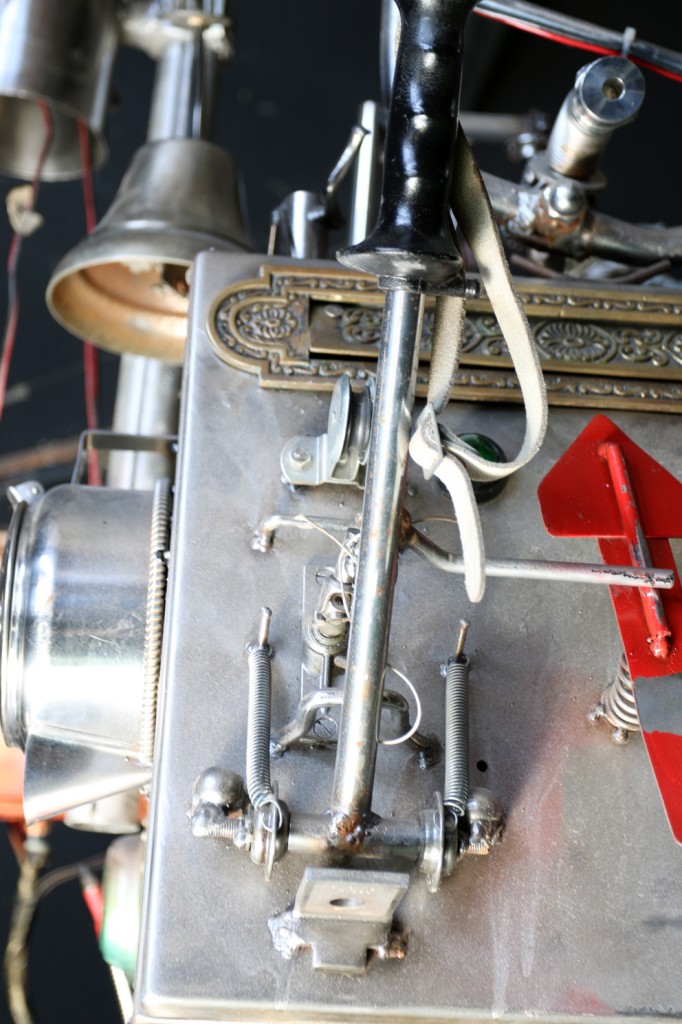
Aan de machine zit een bedieningspaneel met een reeks drukknoppen. Achter verschillende knoppen schuilt een andere reactie: een bel, een claxon, een toeter, mistlampen, koplampen, zwaailampen en verlichting rond de brievenbus. En wie pech heeft, kan zelfs natgespoten worden.
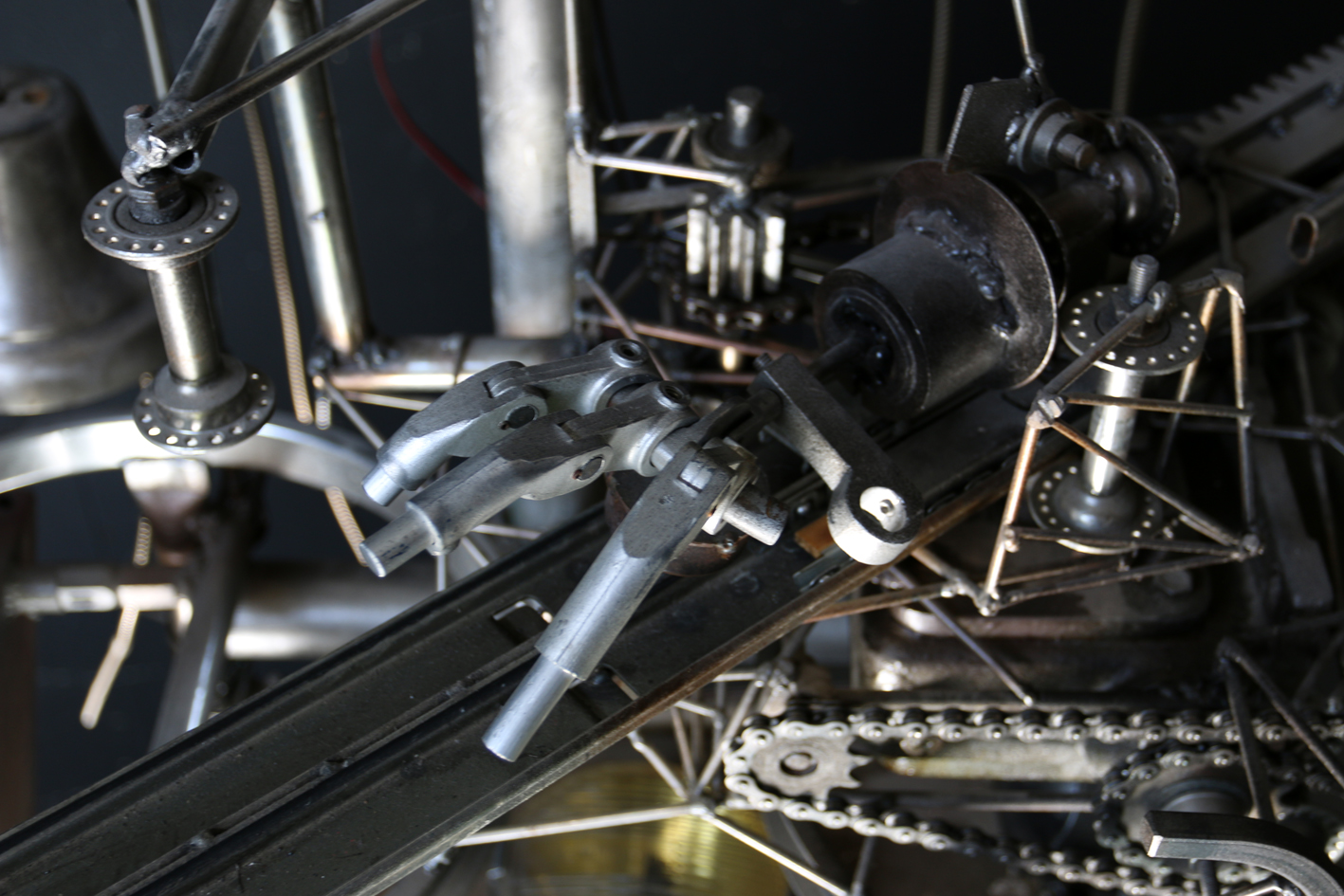
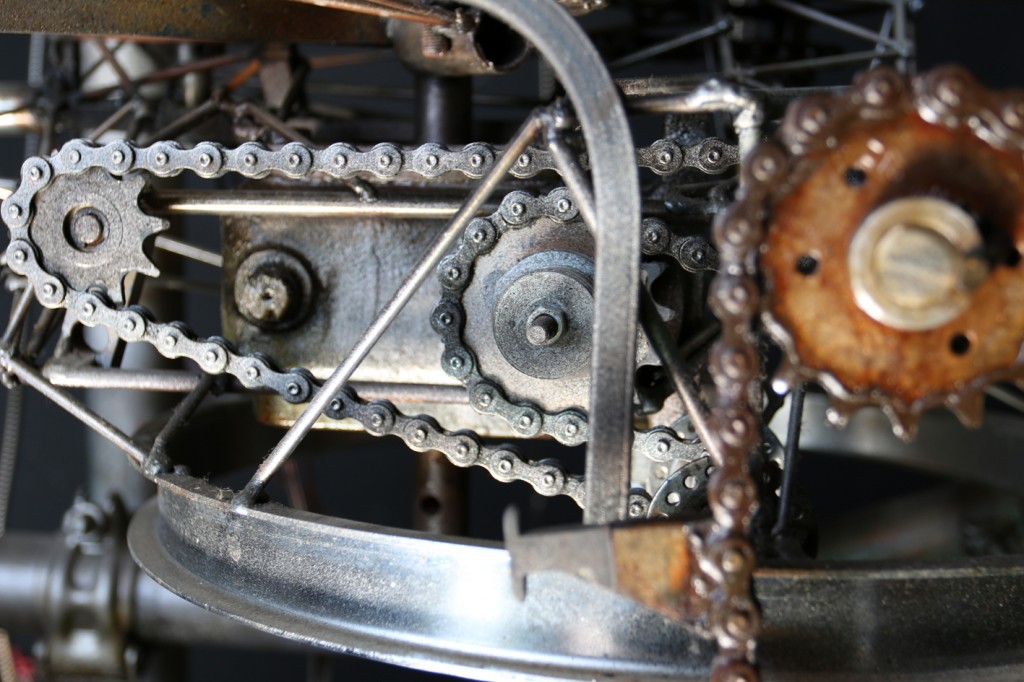
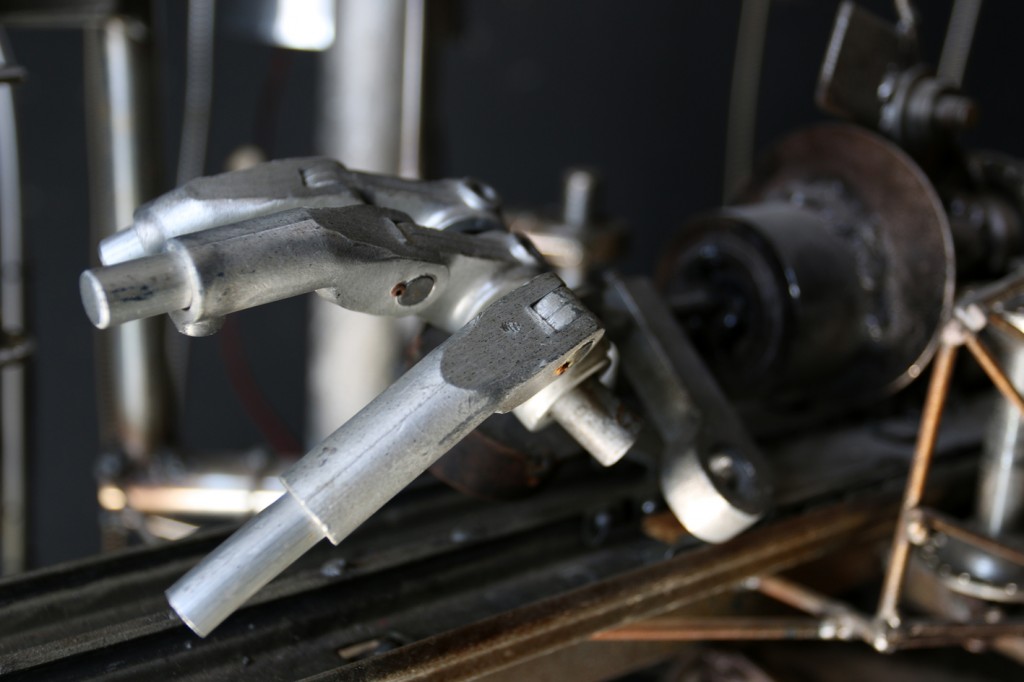
Ook mechanisch valt er van alles te bedienen. Met een hendel kan een heel stelsel van tandwielen in beweging worden gezet, dat uiteindelijk een soort arm met hand laat bewegen. Elders in de constructie komen metalen draden of stangen tot leven zodra de machine wordt geactiveerd.
Het bijzondere is dat niet iedere knop onmiddellijk prijsgeeft wat hij doet. Sommige functies hebben we inmiddels kunnen reconstrueren, andere nog niet. Het is mogelijk dat een deel van de bediening nog functies activeert die we niet hebben teruggevonden. Maar het kan evengoed zijn dat Gosses bewust knoppen zonder voorspelbaar effect toevoegde, zodat de bezoeker nooit precies wist wanneer de machine ineens zou reageren.
En juist dat laatste zou perfect bij hem passen.
De Gosses FFX lijkt namelijk niet ontworpen om rustig en afstandelijk te bekijken. Je moet eraan zitten. Drukken. Draaien. Proberen. Wachten.
Soms gebeurt er niets.
En dan ineens gaat er ergens een claxon af, begint een zwaailicht te draaien, komt een mechanisme in beweging of krijg je water over je heen.
Daarmee wordt het werk bijna een spel tussen mens en machine.
De bezoeker bedient het object, maar heeft nooit helemaal de controle.
Dat onvoorspelbare, bijna ondeugende karakter maakt de installatie misschien wel tot een van de meest complete voorbeelden van Gosses’ manier van werken: techniek, beweging, humor, verrassing en absurditeit allemaal samengebracht in één machine.
Van de Universiteit Utrecht naar onze collectie
Na het lustrum verdween de machine uit het publieke zicht.
Het enorme object kwam in opslag te staan binnen de Utrechtse universiteits-/Parnassosomgeving.
Daar bleef hij jarenlang.
In 2015 kochten wij de Gosses FFX uit die opslag.
Bij het werk waren destijds nog de bovengenoemde documentatie en de originele lustrumkaarten aanwezig.
Wij publiceerden de machine vervolgens al in 2017 op onze website onder de naam Gosses FFX en met de vermelding dat Henk Gosses het werk in 2001 voor het 73e lustrum van de Universiteit Utrecht had gemaakt.
Daarna gebeurde iets wat achteraf bijna komisch is.
Ook bij ons verdween de enorme machine weer de opslag in.
En daar bleef hij nog eens ongeveer elf jaar staan.
Opnieuw tot leven gebracht
Toen we de Gosses FFX uiteindelijk weer tevoorschijn haalden, bleek al snel dat alleen schoonmaken en neerzetten eigenlijk niet genoeg was.
Een machine van Henk Gosses hoort te werken.
Mijn oom Wim Verhoef, zelf uitvinder en technisch zeer ervaren, heeft daarom de installatie volledig nagekeken.
Hij heeft het mechaniek gecontroleerd en de machine opnieuw werkend gemaakt.
En daarmee gebeurde eigenlijk iets heel toepasselijks.
Na jarenlang stil te hebben gestaan, kwam een machine van Henk Gosses opnieuw tot leven.
Pas toen werd ook volledig duidelijk wat voor object we al die jaren hadden opgeslagen.
Want de Gosses FFX is niet alleen indrukwekkend door zijn formaat of door de enorme hoeveelheid onderdelen.
Zijn betekenis zit juist in wat er gebeurt wanneer hij werkt.
Beweging.
Licht.
Mechaniek.
Geluid.
Interactie.
En die typische Gosses-ervaring waarbij je het gevoel krijgt dat een machine een eigen bedoeling heeft.
Geen curiosum, maar een laat werk
Hoe verder we ons in Henk Gosses verdiepten, hoe minder vreemd de Gosses FFX eigenlijk werd.
Dit is geen los curiosum.
Geen gigantische technische grap die toevallig door een robotverzamelaar werd gebouwd.
Het is een laat kinetisch werk van een beeldend kunstenaar die al in 1978 machines als beeldende kunst exposeerde in Museum De Lakenhal.
Meer dan twintig jaar later werkte Gosses nog altijd met hetzelfde fundamentele materiaal:
machines,
beweging,
verwondering,
humor,
en de merkwaardige grens tussen een technisch object en iets dat bijna lijkt te leven.
Alleen was de schaal inmiddels enorm geworden.
De Gosses FFX brengt bovendien verschillende kanten van zijn oeuvre bij elkaar.
De vrije kunstenaar.
De constructeur.
De maker van interactieve machines.
De special-effectsman.
De robotbouwer.
En de man die technische functionaliteit altijd weer wist te combineren met iets absurds.
Zelfs de theepot waarmee je bij de ingestuurde vragen komt, hoort bij dat verhaal.
Misschien hebben we Henk Gosses verkeerd onthouden
Dat is uiteindelijk misschien het meest interessante aan zijn geschiedenis.
Henk Gosses wordt gemakkelijk omschreven als robotverzamelaar, robotbouwer, uitvinder of special-effectsman.
Maar daarmee draaien we zijn ontwikkeling eigenlijk om.
Hij was een beeldend kunstenaar die machines als materiaal koos.
Daaruit kwamen robots voort.
Reclame-objecten.
Special effects.
Fantastische apparaten.
En uiteindelijk een machine als de Gosses FFX.
Zijn kunst ging niet werkelijk over robots.
Ze ging over onze fascinatie voor machines.
Over beweging.
Over fantasie.
Over techniek die iets menselijks krijgt.
En over de wonderlijke grens tussen een levenloos object en iets waarvan je heel even het gevoel krijgt dat het leeft.
Dat maakt zijn werk niet alleen interessant om naar terug te kijken.
Juist nu machines werkelijk steeds zelfstandiger worden, krijgt zijn oeuvre opnieuw betekenis.
Henk Gosses bouwde niet de technologie van onze tijd.
Hij bouwde zijn verbeelding van de toekomst.
En inmiddels zijn we die toekomst binnengewandeld.
Robot Collector Henk Gosses’s Home Movie – Part 1
https://www.youtube.com/watch?v=GGgMzHEb5PY
Robot Collector Henk Gosses’s Home Movie – Part 2
https://www.youtube.com/watch?v=hRcnZLLhwBI
Robot Collector Henk Gosses’s Home Movie – Part 3
https://www.youtube.com/watch?v=9gtnpGcH3_g
Henk Gosses – De Waarzegger / The Fortune Teller
https://www.youtube.com/watch?v=LrhVu5E7DlA
The Auto Gyro Robot Car by Henk Gosses
https://www.youtube.com/watch?v=wam2GRbwVX4
Robotman – Henk Gosses op televisie, 1989
https://www.youtube.com/watch?v=P2F3msThNT8
Bekijk Henk Gosses met Bridget Maasland bij Beeld & Geluid
Henk Gosses is te zien vanaf ca. 14:56.
English description
Unique XL kinetic art object by Henk Gosses – “Gosses FFX”
A very large, interactive kinetic machine full of light, movement, sound and unexpected effects. Henk Gosses made the Dreammachine – GOSSES FFX in 2001 for the 73rd lustrum (five-yearly anniversary) of Utrecht University. Visitors could leave questions in the machine, press buttons and set mechanisms in motion, and were surprised by bells, horns, flashing beacons, moving parts and even water, among other things. The original completed lustrum cards are still with the work. We bought the installation in 2015 from the storage of Utrecht University. After standing idle for many years, the machine has been checked and made to work again. An exceptionally large work by an artist who exhibited his machines as fine art at Museum De Lakenhal as early as 1978, later built robots, worked with Chriet Titulaer and made the famous mechanical objects for the Postbank commercials. Dimensions: 150 cm wide, 88 cm deep and 200 cm high. The Dreammachine is now available for sale. Anyone who sees only a strange technical object is missing half the story. Read on, and you will discover why Henk Gosses and his machines are so strikingly relevant again right now.Henk Gosses – the artist who brought machines to life
Artist, inventor, robot builder and maker of machines unlike anything else. A robot hand that fetches a beer from the fridge. A vacuum cleaner that seems to have a life of its own. A mechanical dachshund for the Postbank. Robots made of tin, gears and old toy parts. Machines that move, smoke, blink, make noise and sometimes seem to exist mainly because Henk Gosses wanted to know whether he could bring them to life. And then there is a construction several metres in size, full of motors, lamps, pipes, rotating parts and technical absurdism: the Gosses FFX. Describing Henk Gosses merely as a robot builder does him an injustice. He was first and foremost a visual artist. An artist who simply preferred working with motors, gears, electronics and found parts to paint and canvas.Machines as art
Hendrik Izaak Gosses was born in Leiden on 10 September 1947 and died on 14 May 2006. In art-historical documentation he is referred to as a sculptor. That is significant, because he later became known mainly as a robot collector, inventor and builder of extraordinary machines. But his roots lay firmly in the visual arts. As early as 1978, when Gosses was thirty years old, he was given an exhibition at Museum De Lakenhal in Leiden under the telling title:Henk Gosses: machines
The exhibition ran from 20 January to 6 March 1978. From early on, then, his machines were presented not as technical curiosities but as works of art. The exhibition was also accompanied by a publication by Hans Sizoo: Henk Gosses (desolation products), Folly Klomp. A copy is now held in the Research Library of the Rijksmuseum. That may well be the best starting point for understanding his entire oeuvre. Gosses made machines. But he made them as an artist.Machines without necessary purpose
Gosses did not build machines because the world urgently needed a more efficient way to fetch a beer from the fridge. Quite the opposite. His constructions were allowed to be complicated, absurd, funny, theatrical and utterly impractical. For him, technology was not an end in itself. It was material. Just as a sculptor uses clay, stone or bronze, Gosses used electric motors, gears, switches, pipes, lamps, springs, tin, old parts and electronics. From these came objects somewhere between sculpture, machine, automaton, robot and character. His machines did something. They moved. They made noise. They smoked. They blinked. And sometimes they almost seemed to have a mood of their own. That is where much of his humour lies. A Gosses machine often appears to be terribly busy with something important, while at the same time you wonder what on earth the thing is actually doing.From machines to robots
His fascination with robots became increasingly important over the course of his life. Gosses collected old robots and space toys, especially the fantastic mechanical toys from Japan of the 1950s and 1960s. But collecting alone was not enough. He modified existing robots, combined parts and built new creations. Sometimes he made not only the robot itself, but also the packaging, name and graphic identity. This makes it hard to see his robots simply as toys. They are sculptures. Assemblages. Small fictional machines from a world that existed only for Gosses.Gustav
One of his best-known creations is the Gustav Robot. Gosses made Gustav in a small edition of just 25 pieces. A documented example, number 12/25, even still has the original box made by Gosses. An edition of 25 is actually exceptional rather than normal within his oeuvre. In the international robot-collecting world, many of Gosses’s other creations are described as one-offs. He did not work as a toy manufacturer. He worked as a maker. Every object could turn out differently.The Giant Motor Robot
Another impressive example is his Giant Motor Robot. Gosses used an existing robot as a starting point, but changed it so radically that an entirely new object emerged. The robot was given new mechanics and functions and could walk, move, light up, produce sound and make smoke, among other things. The packaging also became part of the whole. That is typical of his way of working. He looked at an existing object and apparently saw not what it was, but what it could still become.Robots in the museum and in a book
In 1986 Gosses published Het Robotboek (The Robot Book) together with Chriet Titulaer, with the publisher A.W. Bruna. Titulaer was one of the best-known storytellers about science, technology and the future in the Netherlands. The combination with Gosses was actually logical. Titulaer talked about the future. Gosses built it. In the same year, from 29 March to 3 May, the Rotterdam Municipal Library hosted an exhibition entitled: Robots by Henk Gosses. The line of his development is thus clear. In 1978 he exhibited machines. In 1986 he exhibited robots. But in fact the subject hardly changed. It remained about the boundary between human, technology, fantasy and movement.The Postbank machines
And then his machines suddenly found their way into millions of Dutch living rooms. Gosses also worked on advertising productions and built various bizarre mechanical devices for the well-known Postbank commercials around ‘makkelijk’ and ‘lekker makkelijk’ (‘easy’ and ‘nice and easy’). There he could really let himself go. The machines had to actually work in front of the camera, but at the same time they were allowed to be absurd. Among other things, he built the contraption in which a mechanical hand fetches a beer from the fridge. He made the wondrous vacuum cleaner. An automatic shopping bag. A hairdressing machine. A driving doormat. And various other mechanical devices from the campaign. And then, of course, there was the famous:robot dachshund
A mechanical dog that looks as if someone had put a dachshund, a robot and a science-fiction film into one machine. It is almost impossible to imagine an object that is more Henk Gosses. Technology and humour are completely interwoven in it. Today part of such a commercial could be made digitally. Gosses had to actually build it. The motor had to run. The leg had to move. The arm really had to grab the beer. The vacuum cleaner really had to behave the way the director wanted. That is precisely why this commercial work is surprisingly close to his autonomous art. The client was different. But the maker was the same.Art or special effect?
With Gosses, that distinction actually seems to vanish constantly. He could make a machine for a museum. A robot for himself. An object for a television commercial. Or technical effects for an attraction. For a large project at Center Parcs Port Zélande, for example, he worked on special effects and show control. There too it came down to the same question: how do you make dead material behave as if it were alive? That may well have been his true speciality. Not robots. Not advertising. Not technology. But machines with a soul.Henk Gosses on television
Gosses also appeared on television himself. In a 1989 broadcast he was interviewed as Robotman. In a BNN broadcast of 27 December 2000, Bridget Maasland visited him. Strikingly, the official description by Beeld & Geluid (the Netherlands Institute for Sound and Vision) refers to him as: ‘inventor Henk Gosses’. It says a lot about how differently people saw him. To the museum he was a sculptor. To robot collectors he was a robot builder. To television he was an inventor. To clients he was someone who could actually make impossible machines work. All of those descriptions are probably correct. But none of them is complete.His own world on film
Fortunately, films have also survived in which the world of Henk Gosses can be seen in detail. The three-part series Robot Collector Henk Gosses’s Home Movie is particularly valuable. It shows not only his collection of robots. You see his machines, his own creations and various constructions he made for commercial productions. The machines from the Postbank commercials also appear in it. These films show how little separation there was for Gosses between collecting, making art, technology and daily life. It all seems to be part of one big world. A world full of robots and machines.An artist who suddenly feels highly relevant again
And something curious is happening today. When Gosses built his robots and mechanical helpers, autonomous machines, household robots and artificial assistants still largely belonged to the world of science fiction and futuristic fantasy. Not any more. Robots are actually being developed to take over human tasks in factories, businesses and eventually homes. Artificial intelligence is being linked to moving machines that can perceive their surroundings, understand instructions and act ever more independently. This makes Gosses’s work feel surprisingly relevant all of a sudden. Not because he invented today’s AI robot. He did not. And technically his machines are of course completely different from the robots of today. But the vision of the future he played with is becoming reality. A mechanical arm that jokingly fetches a beer from the fridge in a Postbank commercial was absurdist theatre at the time. Now technology companies are trying to teach robots exactly these kinds of everyday actions. In hindsight the joke takes on something almost visionary. But this is precisely where his artistry remains essential. Gosses was not trying to build the most efficient robot of the future. As an artist, he explored what happens when machines begin to feel more and more human or animal. When a machine gets arms. Or eyes. Or a character. When technology is not just a tool, but a presence. These are questions that may be more relevant now than ever. And so today we look at his work differently than we did twenty or thirty years ago. Not only as something funny or futuristic. But also as an artistic vision of a world that has slowly become reality.International cult status
Although Henk Gosses largely disappeared from view in the Netherlands after his death, outside a relatively small circle, something different happened internationally. In the world of robot and space-toy collectors he was not forgotten. His creations are still recognised, collected, restored and discussed. After his death, a large memorial thread appeared on the international robot forum Alphadrome, in which friends and collectors wrote about him. His work still turns up with specialist collectors. Ten years after his death, a new robot was even built as a tribute to him: the Gosstavo. It used parts that came from Gosses’s estate. That perhaps says more about his influence than any auction record. Other makers recognised in him someone with a completely personal language.The Gosses FFX
And that brings us to the work that led us to delve into Henk Gosses again ourselves. Our collection includes an exceptionally large kinetic work by his hand:GOSSES FFX
The machine was made in 2001 for the 73rd lustrum of Utrecht University, which celebrated its 365th anniversary that year. When we bought the machine, it came with an A4 sheet of information about the object, which mentioned, among other things, the name Gosses FFX, Henk Gosses Dreammachine and its connection with the Utrecht lustrum. Unfortunately we later lost that sheet of paper; we are still looking for it… Fortunately, much of its history turned out to have been literally preserved in the machine itself.A machine full of questions
The Gosses FFX still comes with dozens of original completed question cards from the Utrecht University lustrum. The cards show the campaign around 365 years of Utrecht University and the 2001 Knowledge Festival. Visitors were invited to put a question to the university and its scientists. And that question could actually be posted into the machine. The Gosses FFX contains a letterbox into which the completed cards fell. But as almost nothing with Henk Gosses had to work in a normal way, emptying that letterbox also became part of the object. The compartment where the cards end up can be reached via a teapot in the installation. It is one of those details that reveal his whole way of thinking. Functional. Technical. Absurd. And funny. This made the Gosses FFX much more than a large kinetic sculpture or an unusual letterbox. The visitor became part of the work. The machine has a control panel with a row of push buttons. Behind different buttons lies a different response: a bell, a car horn, a hooter, fog lights, headlights, flashing beacons and lighting around the letterbox. And if you are unlucky, you may even get sprayed with water. Mechanically too, there is plenty to operate. With a lever, a whole system of gears can be set in motion, which ultimately makes a kind of arm with a hand move. Elsewhere in the construction, metal wires or rods come to life as soon as the machine is activated. What is special is that not every button immediately reveals what it does. Some functions we have been able to reconstruct; others not yet. It is possible that part of the controls still activate functions we have not found. But it may just as well be that Gosses deliberately added buttons with no predictable effect, so that the visitor never knew exactly when the machine would suddenly respond. And that last possibility would suit him perfectly. The Gosses FFX does not seem designed to be viewed calmly from a distance. You have to touch it. Press. Turn. Try. Wait. Sometimes nothing happens. And then suddenly a horn goes off somewhere, a beacon starts spinning, a mechanism starts moving, or you get a splash of water. This turns the work almost into a game between human and machine. The visitor operates the object, but is never entirely in control. That unpredictable, almost mischievous character perhaps makes the installation one of the most complete examples of Gosses’s way of working: technology, movement, humour, surprise and absurdity all brought together in one machine.From Utrecht University to our collection
After the lustrum, the machine disappeared from public view. The enormous object ended up in storage within the Utrecht university / Parnassos environment. It stayed there for years. In 2015 we bought the Gosses FFX from that storage. At the time, the documentation mentioned above and the original lustrum cards were still with the work. We then published the machine on our website as early as 2017 under the name Gosses FFX, stating that Henk Gosses had made the work in 2001 for the 73rd lustrum of Utrecht University. Then something happened that, in hindsight, is almost comical. With us, too, the enormous machine disappeared into storage again. And there it stood for roughly another eleven years.Brought back to life
When we finally brought the Gosses FFX out again, it soon became clear that simply cleaning it and putting it on display was not really enough. A Henk Gosses machine is meant to work. My uncle Wim Verhoef, himself an inventor with a great deal of technical experience, therefore checked the entire installation. He inspected the mechanism and made the machine work again. And in doing so, something very fitting actually happened. After standing still for years, a Henk Gosses machine came back to life. Only then did it become fully clear what kind of object we had kept in storage all those years. Because the Gosses FFX is impressive not only for its size or the enormous number of parts. Its meaning lies precisely in what happens when it works. Movement. Light. Mechanics. Sound. Interaction. And that typical Gosses experience of feeling that a machine has an intention of its own.Not a curiosity, but a late work
The more we delved into Henk Gosses, the less strange the Gosses FFX actually became. This is not an isolated curiosity. Not a gigantic technical joke that happened to be built by a robot collector. It is a late kinetic work by a visual artist who exhibited machines as fine art at Museum De Lakenhal as early as 1978. More than twenty years later, Gosses was still working with the same fundamental material: machines, movement, wonder, humour, and the curious boundary between a technical object and something that almost seems alive. Only by now the scale had become enormous. The Gosses FFX also brings together different sides of his oeuvre. The independent artist. The constructor. The maker of interactive machines. The special-effects man. The robot builder. And the man who always managed to combine technical functionality with something absurd. Even the teapot that gives access to the submitted questions belongs to that story.Perhaps we have remembered Henk Gosses wrongly
In the end, that may be the most interesting thing about his history. Henk Gosses is easily described as a robot collector, robot builder, inventor or special-effects man. But in doing so we actually reverse his development. He was a visual artist who chose machines as his material. From that came robots. Advertising objects. Special effects. Fantastic contraptions. And ultimately a machine like the Gosses FFX. His art was not really about robots. It was about our fascination with machines. About movement. About imagination. About technology that takes on something human. And about the wondrous boundary between a lifeless object and something that, for just a moment, gives you the feeling that it is alive. That makes his work not only interesting to look back on. Precisely now that machines are genuinely becoming more and more autonomous, his oeuvre takes on new meaning. Henk Gosses did not build the technology of our time. He built his vision of the future. And by now we have walked into that future. Robot Collector Henk Gosses’s Home Movie – Part 1 https://www.youtube.com/watch?v=GGgMzHEb5PY Robot Collector Henk Gosses’s Home Movie – Part 2 https://www.youtube.com/watch?v=hRcnZLLhwBI Robot Collector Henk Gosses’s Home Movie – Part 3 https://www.youtube.com/watch?v=9gtnpGcH3_g Henk Gosses – De Waarzegger / The Fortune Teller https://www.youtube.com/watch?v=LrhVu5E7DlA The Auto Gyro Robot Car by Henk Gosses https://www.youtube.com/watch?v=wam2GRbwVX4 Robotman – Henk Gosses on television, 1989 https://www.youtube.com/watch?v=P2F3msThNT8 Watch Henk Gosses with Bridget Maasland at Beeld & Geluid Henk Gosses appears from approx. 14:56.Vraag over dit item?
Wil je meer weten over dit product, de prijs, beschikbaarheid of transport? Mail ons gerust. We zien dan meteen over welk item je vraag gaat.
Mail over dit item →