Wat is wabi-sabi wonen — en waarom maakt imperfectie een interieur mooier?

Wat is wabi-sabi wonen — en waarom maakt imperfectie een interieur mooier?

Er zijn interieurs die meteen indruk maken omdat alles klopt. De bank past bij het vloerkleed, de lamp bij de tafel, de kleuren zijn afgestemd, de accessoires staan op precies de juiste plek. En toch kan zo’n interieur soms iets missen. Het is mooi, maar niet spannend. Verzorgd, maar niet persoonlijk. Alsof niemand er ooit echt leeft. Wabi-sabi wonen gaat over precies het tegenovergestelde.

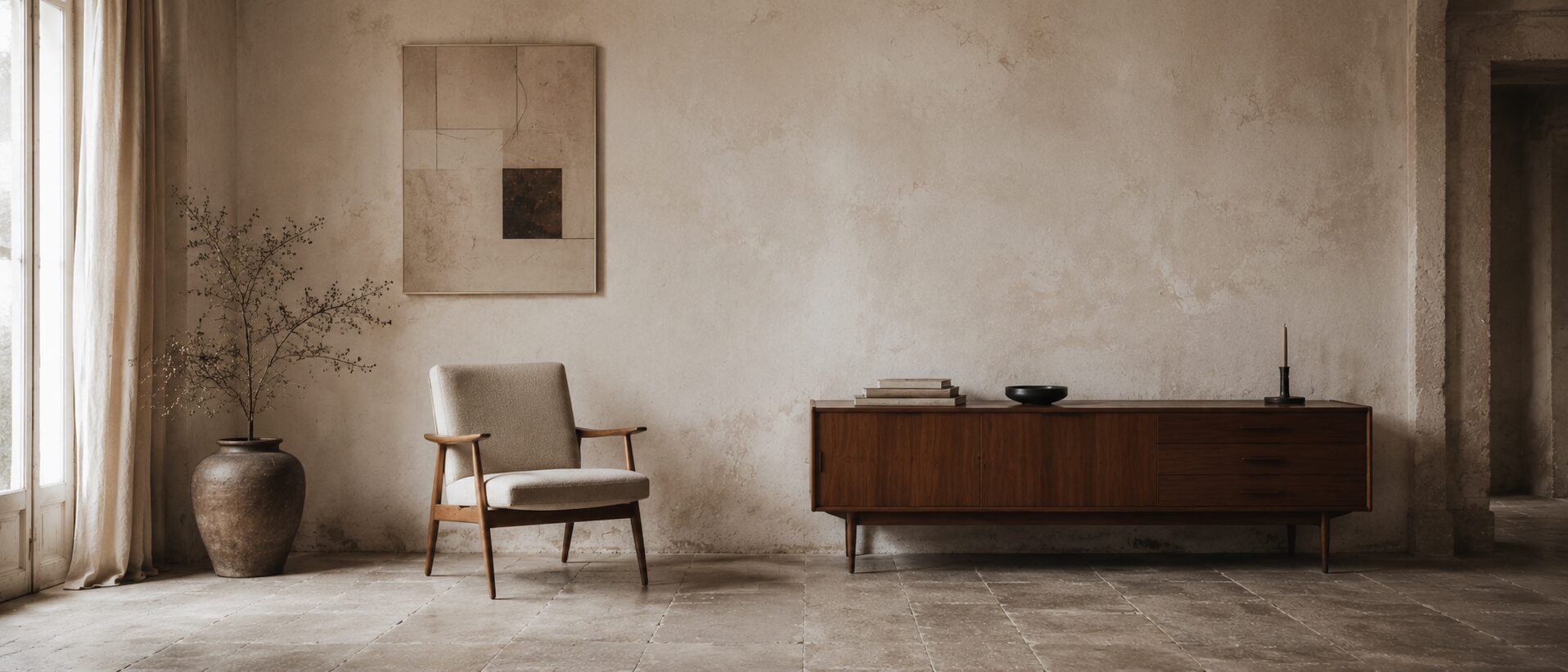
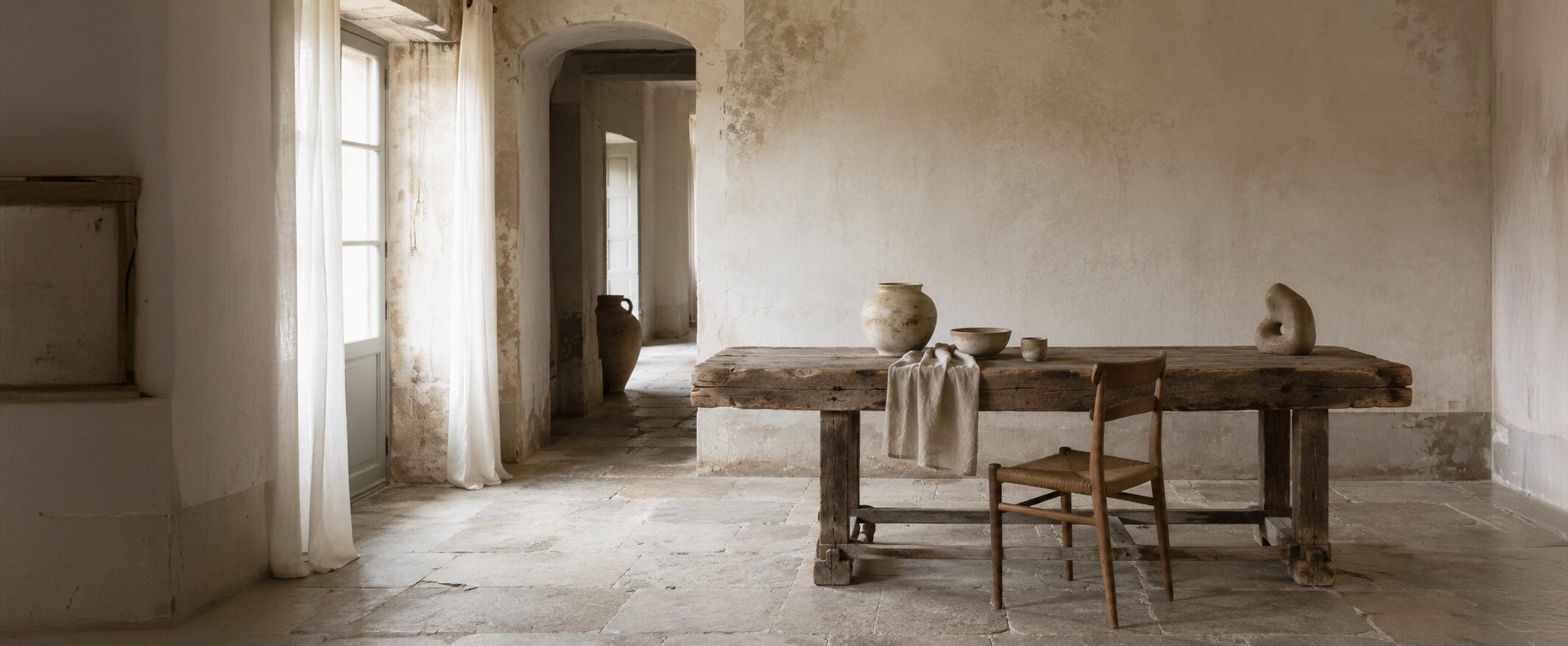
Niet over perfectie, maar over echtheid. Niet over nieuw, glad en vlekkeloos, maar over materialen die iets hebben meegemaakt. Een houten tafel met slijtage aan de rand. Een oude kruik met een onregelmatige vorm. Kalk op de muur, linnen dat kreukt, steen dat door de jaren zachter is geworden. Dingen die niet hun best doen om mooi te zijn, maar het juist daardoor zijn.

Wat betekent wabi-sabi eigenlijk?

Wabi-sabi is een Japanse manier van kijken. Het gaat over schoonheid in eenvoud, vergankelijkheid en imperfectie. Dat klinkt misschien wat zwaar, maar in een interieur is het heel herkenbaar.

Een wabi-sabi interieur voelt rustig, aards en doorleefd. Niet leeg, niet koud, niet gestyled tot in de puntjes. Het heeft stilte, maar ook warmte. Je ziet materialen zoals hout, steen, keramiek, linnen, wol, kalkverf en verweerd metaal. Kleuren zijn vaak ingetogen: zand, krijt, leem, grijs, bruin, zwart, gebroken wit.

Maar het belangrijkste zit niet in de kleurkaart. Het zit in het gevoel.

Een wabi-sabi interieur zegt: het hoeft niet allemaal nieuw, recht, strak en af te zijn. Juist een barst, een vlek, een deuk, een verkleuring of een slijtrand kan een object mooier maken. Niet omdat schade per se mooi is, maar omdat je ziet dat iets echt is.

Patina is geen schade

Bij De Huiszwaluw houden we van spullen waar tijd overheen is gegaan. Een oude Franse tafel met een werkblad vol sporen. Een kast waarvan de verf niet meer overal gelijk is. Een stoel met hout dat door handen, zonlicht en gebruik zachter van kleur is geworden.

Dat noemen we patina.

Patina is het verschil tussen oud en afgeleefd. Een meubel kan gebruikssporen hebben en toch sterk, waardevol en prachtig zijn. Sterker nog: vaak maken die sporen het meubel juist bijzonder. Ze geven diepte. Je voelt dat het stuk niet gisteren uit een doos kwam, maar ergens vandaan komt.

Dat is precies waarom vintage, brocante en antiek zo goed passen bij wabi-sabi wonen. Ze brengen vanzelf gelaagdheid mee. Je hoeft geen sfeer te maken; die zit al in het object.

Rust is niet hetzelfde als saai

Een valkuil bij wabi-sabi is dat het te kaal wordt. Beige muur, beige bank, beige vaas, beige kleed — en dan gebeurt er eigenlijk niets meer. Dan is het geen verstilling, maar verveling.

Een goed wabi-sabi interieur heeft contrast nodig.

Zet ruw naast zacht. Donker naast licht. Strak naast organisch. Een zware houten tafel wordt spannender met een sobere designstoel. Een eenvoudige kalkmuur komt tot leven met een oud schilderij of een sculpturaal object. Een verweerde kast wordt mooier als er niet te veel omheen staat.

Het geheim zit in doseren. Niet alles hoeft bijzonder te zijn. Eén sterk stuk kan genoeg zijn om een hele ruimte karakter te geven.

Hoe combineer je wabi-sabi met andere stijlen?

Wabi-sabi werkt juist goed omdat het geen harde stijl is. Het is eerder een onderlaag, een manier van kiezen.

Met mid-century design krijgt wabi-sabi meer lijn en vorm. Denk aan een sobere houten kast uit de jaren zestig tegen een kalkachtige muur, of een strakke stoel aan een oude Franse tafel. Het contrast tussen helder ontwerp en doorleefd materiaal maakt beide sterker.

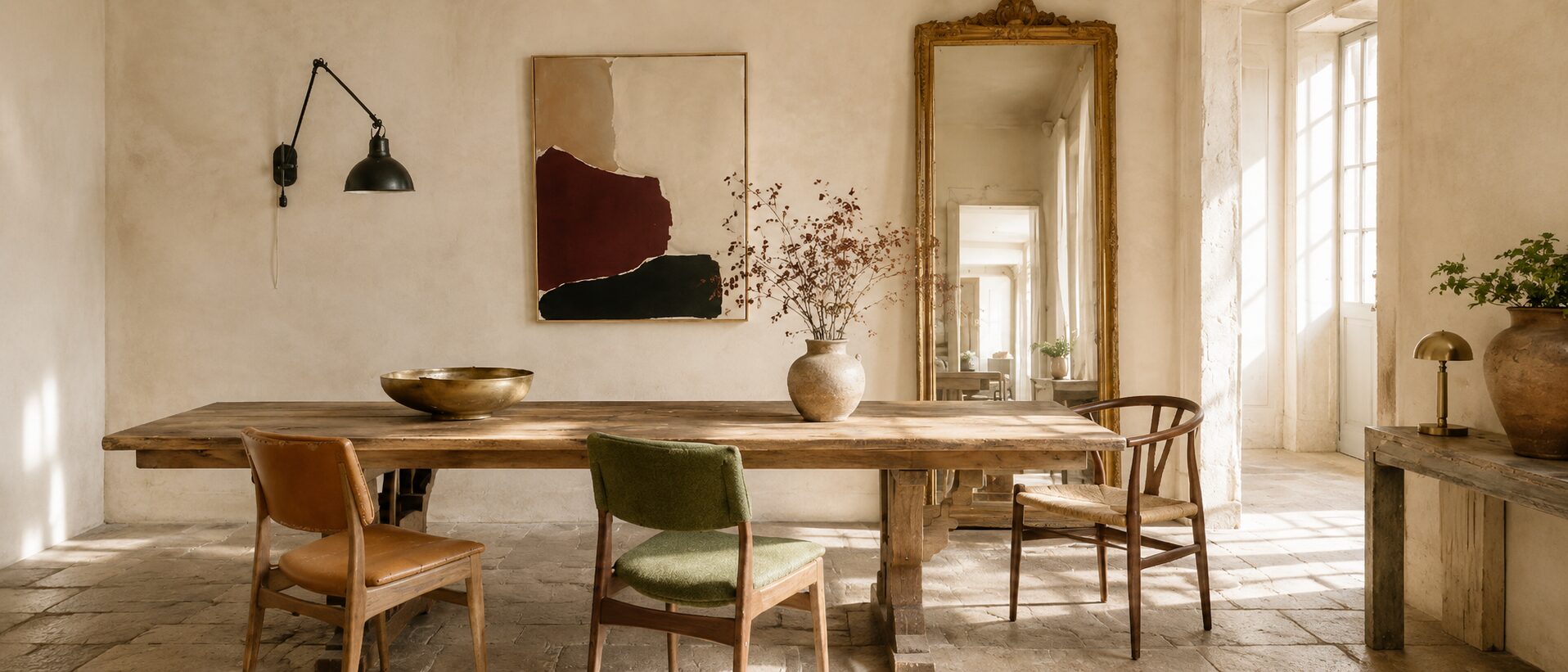
Met brocante krijgt wabi-sabi romantiek, maar dan zonder tuttigheid. Kies liever voor één verweerde tafel, een oude spiegel of een sobere kast dan voor veel kleine frutsels. Houd de basis rustig en laat het oude stuk spreken.

Met industrieel wonen krijgt wabi-sabi stevigheid. Staal, werkbanken, oude lampen en schoolmeubilair kunnen prachtig zijn naast linnen, keramiek en hout. Het voorkomt dat industrieel te hard of koud wordt.

Met kunst wordt wabi-sabi persoonlijk. Een schilderij, een object of een keramisch stuk kan de stilte in een ruimte doorbreken. Niet alles hoeft functioneel te zijn. Soms heeft een kamer juist iets nodig waar je naar blijft kijken.

Waar let je op als je wabi-sabi stukken koopt?

Koop niet zomaar iets omdat het oud is. Oud is niet automatisch mooi.

Let op materiaal. Echt hout, steen, keramiek, linnen, leer en metaal worden vaak mooier met de tijd. Kunststof en fineer kunnen ook interessant zijn, maar vragen om een kritischer blik.

Let op vorm. Een eenvoudig object moet een goede verhouding hebben. Een tafel mag ruw zijn, maar moet wel kloppen in maat en lijn. Een kast mag slijtage hebben, maar moet nog krachtig staan.

Let op gebruik. Een kras is meestal geen probleem. Houtworm, instabiliteit, muffe geur of slechte constructie wel. Patina is mooi, maar een miskoop blijft een miskoop.

En misschien het belangrijkste: koop niet te snel. Een goed stuk moet iets doen. Je moet ernaar willen blijven kijken. Niet omdat het schreeuwt, maar omdat het aanwezigheid heeft.

Hoe zou De Huiszwaluw wabi-sabi toepassen?

Niet als een volledig beige interieur. Niet als een trendhoekje. En zeker niet als een showroom waarin alles zogenaamd “puur” en “zen” moet zijn.

Wij zouden beginnen met één doorleefd meubel. Bijvoorbeeld een oude houten tafel, een sobere kast, een verweerde bank of een object met een sterke vorm. Daaromheen bouwen we rust: een lichte muur, natuurlijke materialen, niet te veel kleur, niet te veel accessoires.

Daarna voegen we spanning toe. Een mid-century stoel. Een industriële lamp. Een schilderij. Een schaal. Iets donkers. Iets onverwachts.

Want een interieur met karakter ontstaat niet door alles in dezelfde sfeer te kopen. Het ontstaat door goed te kijken. Door te voelen wanneer iets klopt. Door stukken te kiezen die elkaar versterken, juist omdat ze niet uit hetzelfde verhaal komen.

Wabi-sabi wonen gaat uiteindelijk niet over perfect stylen. Het gaat over ruimte maken voor dingen die echt zijn.

En dat is misschien waarom het zo aantrekkelijk blijft.

In een wereld waarin zoveel nieuw, glad en snel is, voelt een doorleefd interieur als ademhalen.
English description

What is wabi-sabi living, and why does imperfection make an interior more beautiful?

WABI SABI

What is wabi-sabi living, and why does imperfection make an interior more beautiful?

There are interiors that impress immediately because everything matches. The sofa goes with the rug, the lamp with the table, the colours are coordinated, the accessories are in exactly the right place. And yet such an interior can sometimes lack something. It is beautiful, but not exciting. Well kept, but not personal. As if no one ever really lives there. Wabi-sabi living is about exactly the opposite. Not about perfection, but about authenticity. Not about new, smooth and flawless, but about materials that have been through something. A wooden table with wear along the edge. An old jug with an irregular shape. Lime on the wall, linen that creases, stone that has become softer over the years. Things that don’t try hard to be beautiful, but are beautiful precisely because of that.

What does wabi-sabi actually mean?

Wabi-sabi is a Japanese way of seeing. It is about beauty in simplicity, transience and imperfection. That may sound rather heavy, but in an interior it is very recognisable. A wabi-sabi interior feels calm, earthy and time-worn. Not empty, not cold, not styled down to the last detail. It has stillness, but also warmth. You see materials such as wood, stone, ceramics, linen, wool, lime paint and weathered metal. Colours are often subdued: sand, chalk, clay, grey, brown, black, off-white. But the most important thing isn’t in the colour chart. It is in the feeling. A wabi-sabi interior says: it doesn’t all have to be new, straight, sleek and finished. A crack, a stain, a dent, a discolouration or a worn edge can actually make an object more beautiful. Not because damage is necessarily beautiful, but because you can see that something is real.

Patina is not damage

At De Huiszwaluw we love things that time has passed over. An old French table with a worktop full of marks. A cupboard whose paint is no longer even everywhere. A chair with wood that has softened in colour through hands, sunlight and use. We call that patina. Patina is the difference between old and worn out. A piece of furniture can have signs of use and still be strong, valuable and beautiful. In fact, those marks are often exactly what make the piece special. They give depth. You sense that the piece didn’t come out of a box yesterday, but comes from somewhere. That is exactly why vintage, brocante and antiques suit wabi-sabi living so well. They naturally bring layers with them. You don’t have to create atmosphere; it is already in the object.

Calm is not the same as dull

One pitfall of wabi-sabi is that it becomes too bare. Beige wall, beige sofa, beige vase, beige rug, and then nothing really happens any more. Then it isn’t stillness, but boredom. A good wabi-sabi interior needs contrast. Put rough next to soft. Dark next to light. Sleek next to organic. A heavy wooden table becomes more exciting with a sober design chair. A simple lime-washed wall comes to life with an old painting or a sculptural object. A weathered cupboard becomes more beautiful when there isn’t too much around it. The secret is in the dosage. Not everything has to be special. One strong piece can be enough to give an entire room character.

How do you combine wabi-sabi with other styles?

Wabi-sabi works well precisely because it isn’t a rigid style. It is more of an underlayer, a way of choosing. With mid-century design, wabi-sabi gains more line and form. Think of a sober 1960s wooden cabinet against a lime-like wall, or a sleek chair at an old French table. The contrast between clear design and time-worn material makes both stronger. With brocante, wabi-sabi gains romance, but without being twee. Choose one weathered table, an old mirror or a sober cupboard rather than lots of small knick-knacks. Keep the base calm and let the old piece speak. With industrial living, wabi-sabi gains sturdiness. Steel, workbenches, old lamps and school furniture can be beautiful next to linen, ceramics and wood. It prevents industrial from becoming too hard or cold. With art, wabi-sabi becomes personal. A painting, an object or a ceramic piece can break the stillness in a room. Not everything has to be functional. Sometimes a room needs something you keep looking at.

What should you look for when buying wabi-sabi pieces?

Don’t just buy something because it is old. Old is not automatically beautiful. Look at the material. Real wood, stone, ceramics, linen, leather and metal often become more beautiful with time. Plastic and veneer can also be interesting, but call for a more critical eye. Look at the shape. A simple object must have good proportions. A table may be rough, but its size and line must be right. A cupboard may show wear, but must still stand strong. Look at use. A scratch is usually no problem. Woodworm, instability, a musty smell or poor construction are. Patina is beautiful, but a bad buy remains a bad buy. And perhaps most importantly: don’t buy too quickly. A good piece must do something. You must want to keep looking at it. Not because it shouts, but because it has presence.

How would De Huiszwaluw apply wabi-sabi?

Not as an all-beige interior. Not as a trendy corner. And certainly not as a showroom in which everything supposedly has to be “pure” and “zen”. We would start with one time-worn piece of furniture. For example an old wooden table, a sober cupboard, a weathered bench or an object with a strong shape. Around it we build calm: a light wall, natural materials, not too much colour, not too many accessories. Then we add tension. A mid-century chair. An industrial lamp. A painting. A bowl. Something dark. Something unexpected. Because an interior with character doesn’t come about by buying everything in the same mood. It comes about by looking carefully. By sensing when something is right. By choosing pieces that strengthen each other, precisely because they don’t come from the same story. Ultimately, wabi-sabi living is not about perfect styling. It is about making room for things that are real. And that may be why it remains so appealing. In a world where so much is new, smooth and fast, a time-worn interior feels like breathing.

Vergelijkbare berichten