

Gispen is the best-known Dutch maker of tubular steel furniture and lamps. Willem Hendrik Gispen (1890–1981) started out in Rotterdam in 1916 with a small smithy. The company has been based in Culemborg since 1934. Its chairs of bent tube and its Giso lamps are part of the picture of the Nieuwe Bouwen, Dutch modernism.
From ornamental smithy to factory
Gispen was born in Amsterdam on 7 December 1890. He trained as a schoolteacher and in 1913 went to the academy in Rotterdam, but did not finish the course. In 1916 he bought a smithy on the Coolsestraat and set up W.H. Gispen & Co there, with a staff of two. They made ornamental ironwork by hand.
In 1919 the firm became a limited company: Gispen’s Fabriek voor Metaalbewerking. At the 1925 exhibition in Paris Gispen received a medal for his ironwork.
Giso lamps and steel tube
In 1926 the Giso lamps came on the market and they were a great success. In 1927 Gispen showed his first tubular steel chair in Rotterdam and took part in the exhibition Die Wohnung in Stuttgart. Thanks to a large order for the offices of the Van Nelle factory he could produce the furniture in series as well from 1929.
Gispen supplied the interior of Huis Sonneveld, the Sonneveld house in Rotterdam. From 1933 the factory built the telephone boxes of the PTT, the Dutch post office, to a design by Brinkman & Van der Vlugt. Armchair 412 stayed in production from 1934 to 1966. Reclining chair 404 was part of the furniture for the passenger ship Nieuw Amsterdam.
Designers after the war
In 1949 Gispen stepped down as director. From 1953 Wim Rietveld worked for the factory. He designed office furniture and added furniture for the home and lamps to the range. With his father, Gerrit Rietveld, he designed the Mondial chair in 1957, which was shown at the world’s fair in Brussels in 1958.
In the same years Dick Cordemeijer designed chairs in which plastics played a part, such as polyester with fibreglass. Well-known names are Beter Zitten and Stratus.
Kembo
W.H. Gispen himself left his factory in 1953 after a disagreement with the shareholders. That same year he founded Kembo with his nephew Ru Meijer. His Triënnale 302 chair won a prize at the Milan Triennale in 1954. In 1960 he stopped designing. He died in The Hague on 10 May 1981, the year in which the Stedelijk Museum devoted the first exhibition to him.
What happened later
The factory in Culemborg came to concentrate on office interiors. In 2008 Richard Hutten became creative director. In 2015 Ahrend took the company over. In 2020 production and logistics moved to Sint-Oedenrode; the showroom stayed in Culemborg. The historical archive is kept at Het Nieuwe Instituut in Rotterdam, and the Stichting Gispen Collectie, the Gispen collection foundation, runs a small museum.
How to recognise a Gispen
Look at the tube first: round steel, bent in one flowing line into leg, seat and back. On the pre-war armchairs, Bakelite armrests lie on top of the tube. Every model has a number, such as 404 or 412, and with it you can trace a chair in the old catalogues. Many of W.H. Gispen’s designs are still reproduced by other companies, so an example that looks new is often a later edition. With us you find the pieces from the period itself, with the life that comes with them. We ship worldwide.
Written by De HuiszwaluwGispen
Mid-century
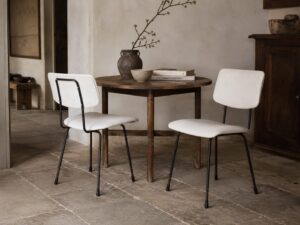
Mid-century
1960 Set of two Dutch Gispen 1231 chairs € 7562 pieces by Gispen found a new home
 Raw beauty and timeless design – Gispen industrial tableSold
 Modern Gispen Cordemeyer Inspired School ChairsSold
 Industrial Vintage Gispen Armchair Kho Liang Ie NaturalSold
 Industrial Vintage Gispen Armchair Kho Liang Ie Bi-ColorSold
 Gispen 1968 Andre Cordemeyer Type 1262 Chair, NaturalSold
 Gispen 1968 Andre Cordemeyer Type 1262 ChairSold
 Industrial Vintage A.R. Cordemeijer Gispen Kleurodesk, 1960sSold
 Industrial Vintage T.H. Delft Gispen School ChairsSold
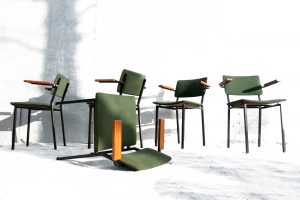 Vintage design Kembo Gispen armchairs greenSold
 Vintage design Kembo Gispen armchair redSold
 Two vintage design Gispen De Wit tubular frame armchairsSold
 Th. Delft Gispen industrial vintage school chairsSold
 Industrial Vintage W. H. Gispen Chairs, 1960sSold
 Industrial Vintage Gispen Cordemeijer AZ Display CabinetSold
 Industrial Vintage Gispen Armchairs Kho Liang IeSold
 Industrial Retro Vintage T.H. Delft Gispen School ChairsSold
 Gispen André Cordemeijer Vintage Industrial Dining TableSold
 Industrial Vintage Cordemeijer Gispen Tri-Colour Chair, 1963Sold
 Industrial Vintage Gispen Desk André Cordemeyer AZ, 1966Sold
 Industrial Vintage Gispen Desk André Cordemeyer AZ, 1966, 2Sold
 Industrial Vintage Metal Drawer Cabinets Gispen / Backfield, 1960sSold
 Retro Vintage Gispen Desk Chair on WheelsSold
 6 Kinds of Th. Delft Gispen Industrial Vintage School ChairsSold
 Industrial Vintage Large Gispen Chest of Drawers, 1950s, Metal, 2Sold
Looking for something by Gispen?
Let us know. We buy every week and will tell you when something comes in. We ship worldwide.