

Pagholz is not a designer but a material: wafer-thin layers of beech veneer, soaked in synthetic resin and pressed into shape under great pressure and heat. You know it from the seats and backs of school chairs and stacking chairs. It is hard, smooth and almost indestructible, which is why those chairs are still around after decades.
What it is
Pagholz is a trade name for resin-impregnated compressed wood. In ordinary plywood the layers are simply glued together. Here each sheet of veneer is first soaked in resin and then compressed into one dense mass. The result is wood that behaves like a very strong plastic but still feels warm to the touch.
Where it comes from
The trade name was registered to PAG Presswerk AG in Essen, Germany. The moulded parts themselves have a longer history in Loitz, in Mecklenburg: the first moulded parts of laminated compressed wood were made there in the 1920s.
In 1998 Woodmark took over the company Pagholz Formteile. Since 2001 it has operated as Pagholz Formteile GmbH from Loitz, where the material is still pressed today.
How it is made
The factory uses only European beech, from Mecklenburg-Western Pomerania and Poland. The logs are steamed for 72 hours so that the wood does not crack later. They are then peeled into veneer 0.3 to 0.4 millimetres thick.
The veneer passes through a bath of synthetic resin; melamine resin is added for the surface. The sheets are stacked and pressed in a mould at 135 to 155 degrees Celsius. The resin softens, the stack takes the shape of the mould and hardens into a single piece.
Who used it
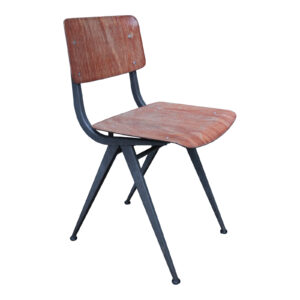
Pagholz is best known for the seat shell. In the Netherlands Galvanitas of Oosterhout, a maker of school and contract furniture since 1934, used seats and backs of resin-impregnated compressed wood on its steel chairs.
According to the factory, about 25 million Pagholz seat shells have been sold worldwide. The material is also used for underground train seats, park benches and trays.
Why it lasts so long
Because the veneer is full of resin, the wood hardly moves any more: it shrinks and swells far less than ordinary wood. The surface resists scratches, wear, knocks and cleaning agents. It is hard to set alight and goes out by itself. Pagholz seat shells withstand temperatures from minus 40 to plus 80 degrees Celsius, so they can stand outdoors too.
How to recognise Pagholz
Look at the edge of the seat or the back. You see very fine layers there, much thinner than in plywood. The surface is dense and hard and yet feels warm. It can be smooth, glossy, matt or lightly textured, and the material has been pressed in various colours. The shell is thin and formed in one piece, without seams. With us you find the chairs from the period itself, with the life that comes with them. We ship worldwide.
Written by De HuiszwaluwPagholz
Mid-century


Postmodern

66 pieces in pagholz found a new home
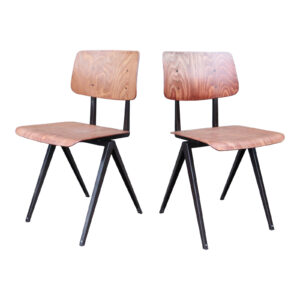 Set of 2 Galvanitas S16 chairsSold
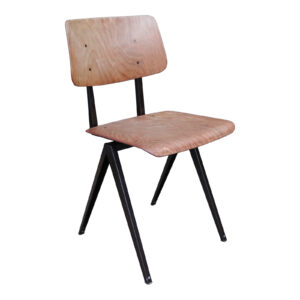 Galvanitas S16 chairSold
 Remarkable vintage Galvanitas S22 chairsSold
 Vintage design Adam Stegner Flototto Germany Pagholz chairs ebonySold
 Vintage Design Obo Eromes Pagholz V-Shape School ChairsSold
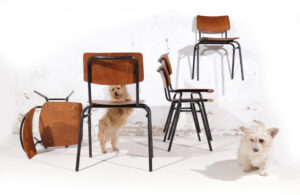 Industrial Vintage School Chairs Pagholz AhrendSold
 Vintage Design Adam Stegner Flototto Germany Pagholz Chairs Golden BrownSold
 Vintage Design Adam Stegner Flototto Germany Pagholz Chairs Red BrownSold
 Industrial Vintage School Chairs Emerald Green Pagholz AhrendSold
 Industrial Vintage School Chairs Dark Olive Green Pagholz PresikhaafSold
 Industrial Vintage School Chairs Pagholz Grey Frame 1960sSold
 Industrial Vintage Elmar Flototto Pagholz School Chairs TOPSold
 TOP! Industrial Vintage School Chairs Eromes 1960s PagholzSold
 Industrial Vintage Tubax School Chairs Pagholz 1977 / 1979Sold
 Industrial Vintage Ahrend de Cirkel School Chairs, Dark Pagholz, Grey Frame, 1980sSold
 Vintage Design Presikhaaf Chairs, Chrome Pagholz, LinkableSold
 Vintage Design Adam Stegner Flötotto Germany Pagholz ChairsSold
 Industrial Vintage OBO Eromes Pagholz School ChairsSold
 Industrial Vintage Obo Eromes Pagholz V-Shaped School ChairsSold
 Industrial Design Pagholz School Chairs, V-Shape ArmrestSold
 3 Industrial Vintage OBO Eromes Pagholz School Chairs, White FrameSold
 Industrial Vintage Ahrend de Cirkel School Chairs, Dark Pagholz, Grey Frame, 1989Sold
 Industrial Design Eromes Pagholz School Chairs with V-Shaped LegsSold
 Industrial Vintage Pagholz School Chairs with Waisted Shell SeatSold
Looking for something in pagholz?
Let us know. We buy every week and will tell you when something comes in. We ship worldwide.