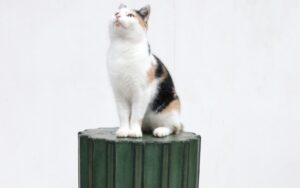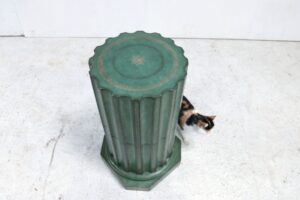

A painting has one side. A sculpture has endless sides. It is made in the round, it casts a shadow and it takes up space, just as you do. That is why you do not put a sculpture away the way you put away a vase. You give it a place, a height and light. Do that well and the room has gained someone: a silent resident you look at for a moment every day.
Walk around it first
Put the sculpture on a table in the middle of the room and walk slowly around it. Almost every sculpture has one principal view, the side from which it says the most, and one or two sides that are also worth seeing. Remember the direction in which it looks or walks: the sculpture looks into the room, not into the wall, and does not stand with its back to the door.
On the ground, among people: the lesson of Rodin
Auguste Rodin (1840–1917) studied his models from every side, at rest and in motion. In 1884 the city of Calais asked him for a monument to six citizens who offered their lives to save their besieged town. The Burghers of Calais was finished in 1889. Rodin did not want the group on a high pedestal but on the ground, so that the townspeople would almost bump into it. The committee disagreed, and in 1895 the work was placed on a high pedestal all the same.
The lesson: height is a choice, not a habit. A high pedestal turns a sculpture into a monument you look up to. Low and close, it becomes someone in the room. At home a figure, a head or an animal may well stand low: on a chest, on a stool or on the floor beside a chair.
The base belongs to the work: the lesson of Brâncuși
Constantin Brâncuși (1876–1957) came from Romania to Paris in 1904 and from 1916 had his studio in the Impasse Ronsin. There he treated the base as part of the sculpture: a support that continues the rhythm of the work, often in different materials one on top of another. In 1926 he showed five bases at a gallery in New York with no sculpture on them.
His bases did not belong to one work for good. He swapped them, drew the sculptures together in groups and moved them almost daily until the whole was right. When he sold a sculpture, he put a plaster cast in the empty place. In 1956 he left the entire studio to the French state, on condition that it be rebuilt as he left it.
The lesson: choose the base with the same care as the sculpture. Rough under smooth, wood under bronze, stone under ceramic: the difference makes both stronger. And keep moving things. A sculpture only stands well once you have tried it in three places.
Air and space: the lesson of Barbara Hepworth
The English sculptor Barbara Hepworth (1903–1975) made her first pierced forms in the early 1930s: sculptures with an opening in them, so that you look through and the space behind joins in. From 1949 until her death she lived and worked at Trewyn Studio in St Ives, with a garden where she could work in the open air. She laid out that garden herself and used it to look at her large bronzes. Since 1976 it has been a museum, and most of the bronzes still stand where she placed them.
The lesson: a sculpture needs air and something to stand out against. Indoors that is a window, a plant or an empty white wall. And through a sculpture with an opening you want to see something: place it so that there is light or space behind it, not a cupboard door.
The right height
Work from your eye. Standing, you look from about 150 to 160 cm. Sitting, from about 110 to 120 cm. A head or a bust is at its best when the face sits just below your own eye level, so that you almost look at each other. In the hall or by the door, where you stand, the middle of the sculpture therefore comes at around 145 cm, just like the centre of a painting. In the seating area it belongs lower, at around 100 to 110 cm.
Then work out the base. If a bust is 40 cm high and you want its middle at 145 cm, the top of the plinth lies at 125 cm. Large sculptures, from a metre upwards, stand on the floor or on a low base of 10 to 20 cm that just lifts them off the ground.
The plinth itself
A plinth is a piece of furniture and has to be in proportion. The top is 2 to 5 cm larger all round than the foot of the sculpture. If it is smaller, the sculpture seems to balance. If it is much larger, the sculpture is standing on a table. Keep the plinth simple: a straight column of wood or stone, or plastered in the colour of the wall.
Background and light
You read a sculpture first as a silhouette. Put a dark sculpture against a pale, empty wall and a pale one against something dark: a wooden cabinet, a deep corner. Keep 20 to 30 cm between sculpture and wall, so that a shadow falls on the wall. That shadow is a second sculpture.
Light only shows form when it comes from the side. Light from the front flattens a face. Light from the side and at an angle from above draws cheekbones, folds and chisel marks. So place a sculpture at right angles to the window. In the evening one small lamp does the work, from one side and slanting down from above, at an angle of 30 to 45 degrees. Never from below: that turns every head into a ghost.
Large, small and heavy
One large sculpture does more than ten small ones. If you have many small figures, do not scatter them through the house but put them together: three or five on one cabinet, of different heights, with the largest at the back and off centre.
Bronze and stone weigh more than you think. Always lift a sculpture by the body and the foot, never by an arm or a neck. A tall, narrow plinth does not belong in a walkway: keep 80 cm clear to walk past. By the window, bronze, stone and glazed ceramics can stand the sun. Wood cannot: it fades and can crack, above a radiator too.
Step by step
Start with one sculpture. Clear the place where it will go, including the wall behind. Walk around the sculpture and choose its principal view. Decide where you will mostly see it from, standing or sitting, and work out the height.
Then build a trial plinth from what you have: a pile of books, a chest, a stool. Put the sculpture on it, at right angles to the window, 20 to 30 cm from the wall, and watch for a day how the light moves across it. In the evening put a lamp beside it and move the lamp until the shadow is right. Only then do you find or make the real base.
How to do it with old pieces
Old sculptures have a skin. Over the years bronze takes on a patina from brown to green, with paler spots where hands have touched it. Wood shows the cut of the gouge, stone the tooth of the chisel, ceramics the fingers of the maker. Do not polish that away.
Old furniture makes the best plinths. A bronze figure on a weathered oak chest, an earthenware head on an old chest of drawers: one old piece carries the other.
This evening, take the small sculpture you have had the longest out of the cabinet and put it alone on an empty table by the window. Walk around it once. You will see it for the first time in years. If you would like another sculpture, or are looking for the chest or cabinet to carry it, do come and look at De Huiszwaluw: there you will find bronze, wooden, stone and ceramic sculptures that already have a life behind them and begin to speak again in a good place. We ship worldwide.
Written by De HuiszwaluwOur pedestals and columns
The eighteenth century
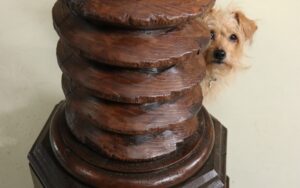
Empire & Napoleon III
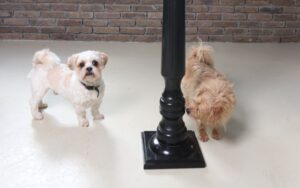 19th century
Ebony column with fluted shaft
€ 395
 19th century
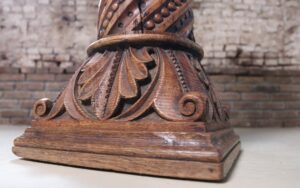
Carved oak column with twisted shaft, beaded borders and acanthus base
€ 450
 second half of the 19th century
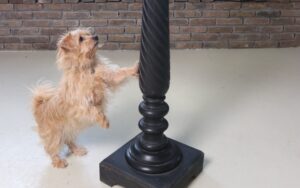
Blackened wooden column with turned spiral shaft
€ 295
 late 19th century
Old French wooden plant column with carved grape motifs
€ 495