

Velvet is a fabric you read with your hand first and only then with your eyes. Stroke it and the colour changes: dark and deep one way, pale the other. That is the work of the pile, the thousands of short threads standing upright in the weave. Velours and velvet are found on chairs and sofas from the nineteenth century to the 1970s, and a good quality lasts longer than you would expect of such a soft fabric.
What it is
Velvet is a woven fabric with a dense, even pile. Velours is the French word for velvet; for upholstery fabric the two names are used interchangeably. The pile is not glued onto the cloth or pushed into it, but woven in. Alongside the ordinary threads runs an extra warp thread that makes a small loop above the weave each time.
This is done in two ways. In the old way the weaver carries the pile thread over thin steel rods. A rod with a small blade at the end cuts the loops open as it is pulled out; a rod without a blade leaves them whole. In the other way two layers of cloth are made at once, with the pile threads between them. A knife cuts the layers apart, and you have two pieces of velvet.
Where it comes from
The technique comes from Asia. In Europe velvet is first mentioned in the early fourteenth century. Around 1400 weaving flourished in Italy, above all in Lucca, Florence, Venice and Genoa. In the sixteenth century Bruges became a centre of velvet weavers.
For centuries velvet was made of silk, and only for those who could pay for it. That changed in the nineteenth century. Looms came to run on mechanical power, and from the 1830s velvet was woven as a double cloth, which brought the price down sharply. From then on an ordinary armchair could be covered in velvet, in cotton, wool or mohair.
Cotton, mohair and cord
Cotton velvet is the everyday kind: soft, matt and warm in colour. Mohair velvet is the strong kind. Mohair is the hair of the Angora goat, which until 1849 was kept only in the region around Ankara. The hair has a lustre, springs back and takes dye very well. That is why you find mohair velvet on chairs that have been sat on a great deal.
You recognise corduroy by the ridges running lengthwise. The pile does not stand equally high everywhere, but in bands with a small channel between them. In French it is called velours côtelé, in many languages also rib or rib cord, and in a number of countries people simply called it Manchester. Corduroy has been used in Europe since the eighteenth century. The wide cord is the cord of trousers and of furniture, and in the 1970s corduroy became popular everywhere.
Then there are the worked kinds. In embossed velvet a hot metal roller presses a pattern into the pile. In ciselé, cut and uncut loops alternate, so that the pattern sits in the weave itself. More recent velvet is often made of polyester, nylon or viscose.
Trijp, the velvet of Utrecht
Trijp is the Dutch name for a pile fabric that can take hard use. The simple kind has a pile of wool, the better kind a short pile of mohair. That better kind is now called mohair velvet. Abroad it is known as velours d’Utrecht, Utrecht velvet or Utrechter Plüsch, after the Dutch city of Utrecht.
How that name came about is something the sources do not agree on. One source places the beginning at a weaving mill in the city of Utrecht at the end of the seventeenth century, another points to woollen velvet from northern France, and a third calls the name Utrecht for all that Dutch velvet inaccurate. We keep to what is certain.
What is certain is that trijp flourished again in the Netherlands around 1900. In 1887 the factory of Schellens en Marto started in Eindhoven. In Hengelo, in the east of the country, the Hengelosche Trijpweverij worked from 1901 to 2000. There the cloth was woven and the patterns were rolled into it with steam, slow and costly work. Artists drew the patterns: Theo Nieuwenhuis designed for Hengelo from 1910, Chris Lebeau for Schellens in Eindhoven. In the 1920s and 1930s trijp belonged to the interior of the Amsterdam School, the Dutch expressionist style of those years.
How to recognise it
Start with the nap, the direction in which the pile lies. Stroke the seat with the flat of your hand. With the nap it feels smooth and the fabric turns paler; against the nap it feels rough and turns dark. A fabric without a pile does not do that.
Then look at a place where the fabric is worn, or bend it open at a seam. You will see the ground weave in which the pile stands. In corduroy you see the bands and the channels. You recognise mohair by its lustre and its spring: press the pile flat and it stands up again. In embossed trijp the pattern lies slightly deeper than the rest, as if it had been stamped in.
What to look for when you buy
Velvet wears in fixed places: the front edge of the seat, the armrests, the place where the head rests. There the pile first goes flat and then disappears, until you see the bare ground weave. A flat pile is not damage. Light and dark patches belong to every pile fabric, because flattened threads reflect the light differently. A bare patch does not come back.
Look at the colour too. Compare the back or the side that stood near the window with a place that was always in shadow, for instance under a loose cushion. Ask whether the upholstery is still the original. A chair that has been re-covered is not a lesser chair, but you want to know.
Care in brief
Brush or vacuum velvet with the nap, using a soft brush. Do not rub at a stain and do not soak the fabric. You can read more in the book Caring for rugs and upholstery on the Care shelf.
Why we love it
Velvet is matt and deep at the same time. It does not shine; it catches the light and gives it back softly, and in a pale room with few things one chair in old velvet is colour enough. The wear belongs to it: an armrest that has grown a little paler tells you where someone laid a hand for years. You will find the pieces with velvet and trijp from our collection below, and all of them already have a life behind them. We ship worldwide.
Written by De HuiszwaluwVelvet
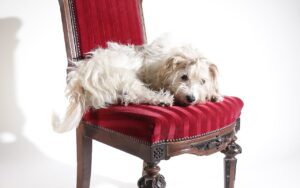
Empire & Napoleon III
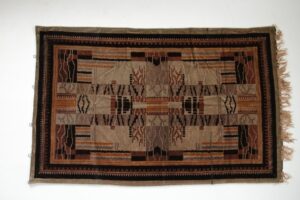
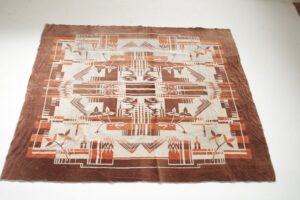
Art deco
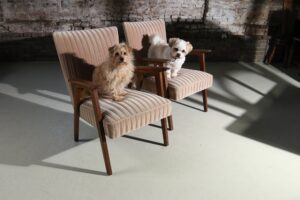
Mid-century
Postmodern

Empire & Napoleon III
1860 Nineteenth-century French carved chair with red velvet € 345Art deco
1935 Art Deco velour rug with fringes € 145 1935 Art Deco velour rug in orange and brown € 195Mid-century
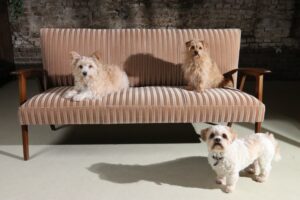
1955 Pair of Vintage Armchairs in Striped Velvet € 495 1965 Vintage three-seater sofa with striped velvet € 545Postmodern
1985 Memphis Style Belgo Chrom Chairs, Stainless Steel and Green Velvet, 1980s € 3957 pieces in velvet found a new home
 XL vintage velour wall hanging “Red deer stag & hinds”Sold
 Design Armchair, Black / Faded Green-Grey VelourSold
 Vintage Louis XV armchair faded green velourSold
 Retro Style Velour Sofa on High LegsSold
 Vintage Sixties Three-Seater Sofa, Golden Yellow VelourSold
 Great Retro Vintage Button-Tufted Velour Armchair, 1960sSold
 Retro Vintage (Small) Armchair 1960s VelourSold
Looking for something in velvet?
Let us know. We buy every week and will tell you when something comes in. We ship worldwide.