

Leather is an animal hide made durable by tanning. It is strong and supple and lasts for decades, and it is one of the few materials that grow more beautiful with use. That is why it is found on so many old chairs and sofas: from the English Chesterfield to the Danish armchair with a seat of saddle leather. But leather is not one thing. How it was tanned and finished decides how it looks, how it ages and what you may expect of it.
What it is
A raw hide decays. Tanning is the treatment that prevents this: tanning agents bind to the protein in the hide, collagen, and turn it into a lasting material. Most leather is cattle hide; about 65 per cent of all leather comes from cattle.
Vegetable-tanned and chrome-tanned
The old way is vegetable tanning. The tanning agent, tannin, comes from tree bark and other parts of plants, such as oak, chestnut, quebracho and mimosa. The hides hang for weeks in vats with an ever stronger tanning liquor. The leather that comes out is firm and not very supple, naturally light brown, and it is used for furniture, luggage, belts and shoes. It stands up poorly to water, which discolours it.
The new way is chrome tanning, with chromium sulphate and other chromium salts. The method was developed in the second half of the nineteenth century; the American Augustus Schultz was granted a patent for it in New York in 1884. The tanning itself takes less than a day. Chrome leather is more supple and more elastic than vegetable-tanned leather. Today 85 to 90 per cent of all leather is made this way. The raw chrome leather is grey-blue and is known in the trade as wet blue; the colour comes only afterwards.
Grain leather and split leather
A hide is split into layers. The top layer, with the outside of the hide, is called the grain. There the fibres are finest and most tightly packed. Leather in which the whole grain has been left intact is called full-grain leather and is regarded as the best quality. It does not wear away, but acquires a patina in the course of its life.
If the surface has been treated to make it more even, it is called corrected grain. Nubuck is grain leather that has been lightly buffed on the grain side to a velvety surface. The layer beneath the grain is split leather. Suede is made from the underside of such a split. Right at the bottom comes bonded leather: shredded leather scraps glued with polyurethane or latex on to a fibre backing.
Aniline, semi-aniline and pigmented
Then the finish. Aniline leather is coloured only with soluble dyes, with no opaque coat on top. You see the hide itself: pores, scars, creases. Because nothing is hidden, only the best hides are used for it. If aniline leather is given an extra layer of oil or wax, it is called pull-up leather; that gives it a lived-in look.
Semi-aniline leather is made in the same way, but is given a thin protective topcoat against wear and stains. Pigmented leather has an opaque coat containing pigment, which hides the natural surface under a single even colour. Pores and scars are no longer visible there.
Saddle leather
Saddle leather, also called harness leather (tuigleer in Dutch), is thick, vegetable-tanned cattle leather, from just over a millimetre to as much as four millimetres. It was made for horse harness and was also used for the drive belts of machines. It is so firm that it needs no padding or support: a seat or back of saddle leather is simply stretched between the frame.
Natural saddle leather starts out pale, almost pink. Light makes it darker over months and years, until it is a warm cognac colour. It stretches a little with time; that is why there are often straps, buckles or a lace under the seat to tighten it again. Scratches and small marks are part of it and are the proof that it is real.
Well-known leather furniture
The Chesterfield is a deep-buttoned sofa, usually in leather, with arms and back at the same height. The story goes that Philip Stanhope, the fourth Earl of Chesterfield (1694–1773), had the first one made. What is certain is that the sofa became popular in English homes in the middle of the nineteenth century. The club chair comes from France, where it was first called the fauteuil confortable, and belongs to Art Deco. Where the word club comes from is not clear.
The Danes used leather sparingly and visibly. At the end of the 1950s Børge Mogensen (1914–1972) made his Spanish Chair: a frame of solid oak with a seat and back of saddle leather. Poul Kjærholm (1929–1980) chose steel as his material and combined it with leather, cane, wood or marble; his best-known chair is the PK22 of 1956.
In the Netherlands Martin Visser drew the SZ02 armchair for ’t Spectrum in Bergeijk, a village in the south of the country: a frame of tubular steel with a seat and back of black or natural saddle leather, tightened with a lace under the seat and a buckle behind the back. You see it in the 1960s and 1970s.
Leather or artificial leather
Artificial leather, often called skai in the Netherlands, is a layer of plastic on a textile backing. You see the difference in four places. The pores: in real leather they are irregular, in artificial leather the pattern repeats. The edge: real leather is rough and fibrous there, artificial leather shows a smooth layer with fabric beneath. The back: leather is fibrous like suede, artificial leather has a cloth back. And the smell: leather smells of leather, artificial leather of plastic. Skai has a book of its own on this shelf.
What to look for when you buy
First see which leather it is. Aniline leather and natural saddle leather have no protective coat and are sensitive to water and stains. Stains and discolouration are part of such a piece, but they will not come out again. With pigmented leather, check that the colour coat has not cracked and is not flaking in the places where people have sat most.
Feel whether the leather is still supple. Dried-out leather is hard and breaks at the folds. Look at the seams and at the edges of the seat, and on saddle leather at the holes the straps pass through: that is where it tears first. Ask whether the upholstery is original. New leather on an old frame is not a problem, but you ought to know.
Care in brief
Keep leather out of full sun and away from radiators. Dust it with a dry, soft cloth and be sparing with water, especially on aniline leather and saddle leather. There is more in the book Caring for leather on the Care shelf.
Why we love it
No material tells so well how it has been used. Leather grows darker where hands have touched it and softer where someone has sat for years. In a light, calm room one leather chair is enough: it brings warmth and depth without shining. Old leather is matt and lived-in, and that is exactly what we look for. You will find the pieces with leather from our collection below, and every one of them already has a life behind it. We ship worldwide.
Written by De HuiszwaluwLeather
Art nouveau
Art deco
 circa 1920
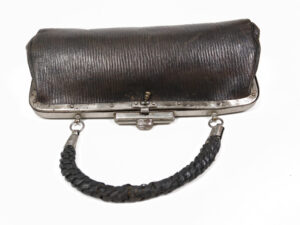
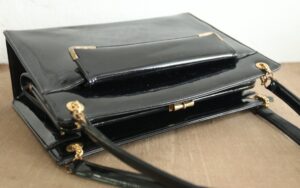
Small Art Deco evening bag in black ribbed leather
€ 145
 circa 1920
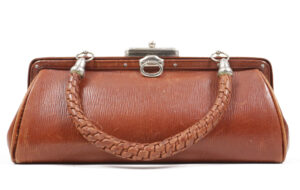
Small Art Deco evening bag in brown ribbed leather
€ 195
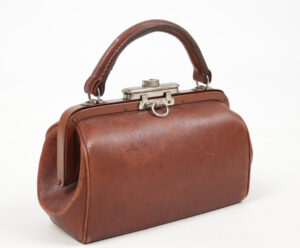 circa 1920
Art Deco handbag in brown ribbed leather
€ 195
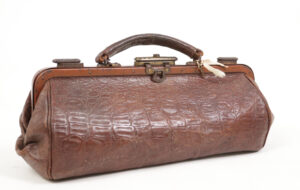 circa 1920
Antique French Art Deco doctor’s bag in crocodile-print leather
€ 145
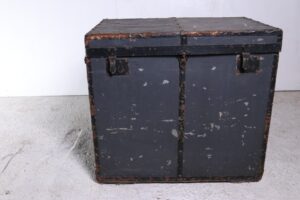 early 20th century
Large antique travel trunk
€ 95
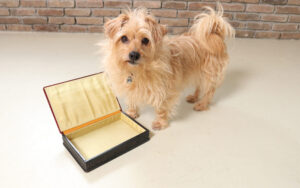 first half of the 20th century
Black leather box with leather medallion and red laced edge
€ 65
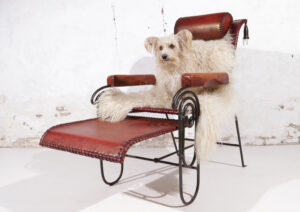 1930
French Art Deco lounge chair in wrought iron and leather with extendable footrest
€ 1.295
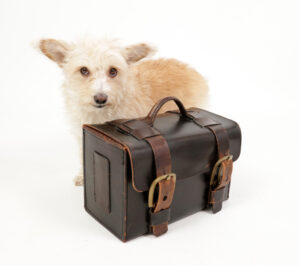 1930s
Industrial harness leather tool case with brass buckles
€ 145
Mid-century
Postmodern
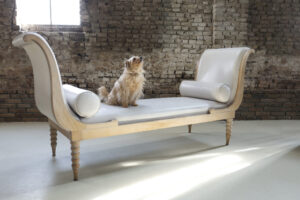 second half of the 20th century
Vintage chaise longue / daybed in bleached wood and white leather
€ 995
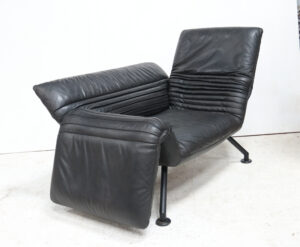 designed 1988, this example made in the 1980s
De Sede DS-142 armchair / daybed
€ 1.950
 1985
Vintage wooden dining chair
€ 35
 1980s (1989)
Large Dutch Design Vilma Henkelman Unica Leerdam Art Glass Vase, 1989
€ 395
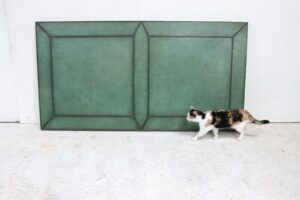 c. 1990
Maitland-Smith table top clad in green leather
€ 545
 c. 1990
Maitland-Smith column clad in green leather
€ 655
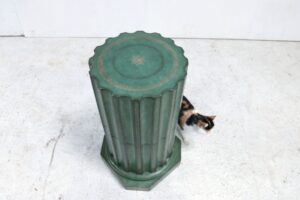 c. 1990
Maitland-Smith column clad in green leather
€ 655
 circa 1991
Paolo Gucci for Formitalia
€ 1.795
Contemporary

Timeless
Art nouveau
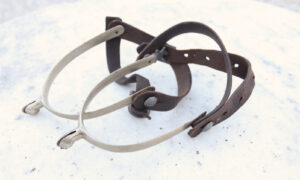
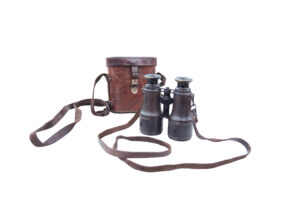
1914 Riding spurs with rowels and leather spur straps € 65 1914 Antique French binoculars Lemaire Paris with leather case € 165Art deco
1920 Small Art Deco evening bag in black ribbed leather € 145 1920 Small Art Deco evening bag in brown ribbed leather € 195 1920 Art Deco handbag in brown ribbed leather € 195 1920 Antique French Art Deco doctor’s bag in crocodile-print leather € 145 1925 Large antique travel trunk € 95 1925 Black leather box with leather medallion and red laced edge € 65 1930 French Art Deco lounge chair in wrought iron and leather with extendable footrest € 1.295 1935 Industrial harness leather tool case with brass buckles € 145Mid-century
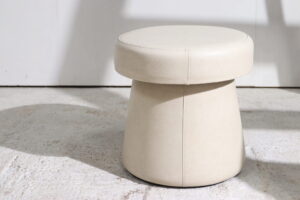
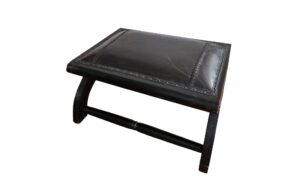
1950 Cream leather pouffe with storage € 95 1950 Black leather footstool with curved legs € 65 1955 Vintage Coblentz Original handbag € 165Postmodern
1975 Vintage chaise longue / daybed in bleached wood and white leather € 995 1985 De Sede DS-142 armchair / daybed € 1.950 1985 Vintage wooden dining chair € 35 1985 Large Dutch Design Vilma Henkelman Unica Leerdam Art Glass Vase, 1989 € 395 1990 Maitland-Smith table top clad in green leather € 545 1990 Maitland-Smith column clad in green leather € 655 1990 Maitland-Smith column clad in green leather € 655 1991 Paolo Gucci for Formitalia € 1.795Contemporary
2002 Unica design thick-walled vase by Roel Olivier, Leerdam glass € 130Timeless
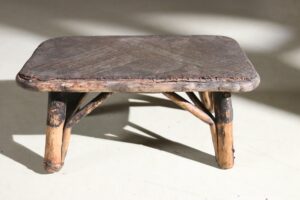
Small Old Bamboo Footstool with Leather Top € 135100 pieces in leather found a new home
 Vintage black leather deep tubular frame lounge sofaSold
 Vintage black leather deep tubular frame armchairSold
 Vintage Design Armchair White Leather / ChromeSold
 Dark Blue Leather Hocker Japanese StyleSold
 Vintage Design Leather Patchwork Pouf 1960sSold
 Vintage Chesterfield Chair Jeans Blue LeatherSold
 4 Italian Design Harness Leather Chrome Tubular Frame Chairs 1980sSold
 Vintage Design Bamboo Bohemian Brutalist Harness Leather Armchair 1970sSold
 Vintage Design 80’s Stylish Wire Steel Chairs Chrome Black LeatherSold
 Vintage Danish Design Footstool Ottoman Leather TeakSold
 Old Rugged Castle Chair Large Nails and LeatherSold
 Vintage Leather Club Armchair, 1930sSold
 George I Style Armchairs, Antelope LeatherSold
 Two Relax Leather Cognac Colour ArmchairsSold
 4 Memphis Milano Style Castelijn Model SLA Armchairs, Purple LeatherSold
 Design Stacking Chairs Casala Curvy by Sigurd Rothe, Leather with ArmrestsSold
 Industrial Vintage Pagholz School Chairs with Waisted Shell SeatSold
 Super Cool White Leather Armchair from the 1980sSold
 Rugged Vintage Leather Patchwork Pouf, 1980sSold
 Industrial Metal and Cowhide Genuine Leather “De Huiszwaluw” BenchSold
 Vintage Design Black Leather Buttoned Armchairs, 1960sSold
 Vintage Baroque Leather Buttoned ArmchairSold
 Vintage Design De Sede DS 46 Buffalo Leather Modular SofaSold
 American Vintage Design Armchair, Antelope Leather, 1980sSold
Looking for something in leather?
Let us know. We buy every week and will tell you when something comes in. We ship worldwide.