

Skai is artificial leather: a layer of plastic on a textile backing, with an embossed surface that looks like leather. It was cheap, strong and could be cleaned with a damp cloth, and that is why it is found on countless chairs from the 1950s to the 1970s. Skai is really a brand name, but the word has become so ordinary that in Dutch and German it is used for all artificial leather.
What it is
Artificial leather is an imitation of leather consisting of a plastic on a textile backing. In skai and most old kinds that plastic is PVC, polyvinyl chloride. PVC is hard and brittle by nature. It only becomes flexible once a plasticiser has been mixed into it, a substance that settles between the chains of the plastic.
The soft PVC is applied as a layer to woven or knitted fabric. The grain pattern is put in by embossing, or by casting the layer on paper that carries the grain in mirror image. The result comes off the roll. An upholsterer does not have to cut round scars or the shape of a hide.
Where Skai comes from
Skai is a brand of the German firm Konrad Hornschuch, named after its founder Konrad Hornschuch (1864–1943). The company had factories in Urbach and in Weißbach, a place near Künzelsau in Baden-Württemberg. The factory in Weißbach had begun in the nineteenth century as a textile mill and had made artificial leather since the 1920s.
In 1958 Hornschuch brought two brands on to the market that both became household names: the artificial leather skai and the self-adhesive decorative film d-c-fix. In 1976 the head office moved to Weißbach. The name skai became so established that it appears as an ordinary word for artificial leather in the German dictionary Duden and in the Dutch dictionary Van Dale. Since 2017 the company has belonged to the German group Continental.
Forerunners and other names
Artificial leather is older than PVC. The British Rexine, made in Hyde near Manchester, was cloth with a coating of nitrocellulose and an embossed surface. It cost about a quarter of the price of real leather and was used in British cars and trains from the 1920s. In America DuPont made something similar on cotton, under the name Fabrikoid.
The step to PVC could be taken when Waldo Semon, at the American company B.F. Goodrich, found a way in 1926 of making PVC soft with additives. The best-known American brand is Naugahyde, named after the town of Naugatuck in Connecticut where it was first made; the name has been in use as a trademark since 1936. It is a knitted fabric with a layer of expanded PVC.
Other names you come across are leatherette, imitation leather, vinyl and, in German, Kunstleder. They are used interchangeably. Leatherette is a cloth with a soft layer of PVC; vinyl refers to the PVC itself.
On chairs from the 1950s to the 1970s
Artificial leather is used above all as upholstery: on chairs and sofas and in cars. The advantages were obvious. It does not absorb moisture or let it through, it is cheaper than leather, the quality is always the same and you can wipe it clean. That made it the natural material for places where many people sit and where things get spilt.
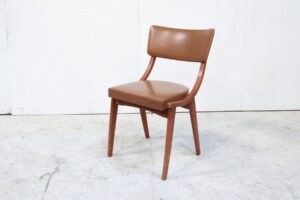
So we see it mainly on chairs for the kitchen, the office, the canteen and the school: a thin upholstered seat and back on a frame of tubular steel or wood. On such chairs skai is not an imitation that hides something. It is the material the designer chose, and it belongs to the piece.
PVC and polyurethane
There are two large families. Artificial leather made of PVC does not absorb moisture and feels dense and smooth. Artificial leather made of polyurethane has a structure with very fine pores and breathes. The old skai of school chairs and kitchen chairs is of the first kind.
How it ages
Leather acquires a patina. PVC ages differently, and the cause is the plasticiser. It is not chemically bound to the plastic and slowly leaves it over the years. First it comes to the surface: the artificial leather turns sticky and holds dust and dirt. Then, as less and less plasticiser remains, the material becomes stiff and brittle. It shrinks, it cracks where it bends, and it discolours.
That process cannot be reversed. You can only slow it down. Skai that has gone hard will not turn soft again, and a crack keeps growing when the seat is used.
How to tell it from leather
Look at the back, at a seam or under the seat. Artificial leather has a back of woven or knitted fabric. Leather is rough and fibrous there, like suede. Then look at a cut edge: on artificial leather you see a smooth layer of plastic with fabric beneath, on leather a single fibrous mass.
Look at the grain as well. In leather the pores are irregular and no spot is like another. In artificial leather the pattern is embossed and repeats. Finally, smell it: leather smells of leather, artificial leather of plastic. And leather absorbs moisture, whereas a drop of water just sits on PVC.
What to look for when you buy
Feel it first. Good skai is supple and gives under your thumb. If it feels hard, or sticky, the plasticiser is disappearing. Look for small cracks on the front edge of the seat, in the corners and along the seams: that is where it starts. Check that the covering has not shrunk and is not pulling at the staples or the piping.
Small worn patches belong to a chair that has been used. A seat that is cracked across its whole width has to be re-covered. That is perfectly possible, and it takes nothing away from the frame, but you ought to know what you are buying. Ask, too, whether the skai is original.
Care in brief
Wipe skai with a damp cloth and dry it afterwards. Keep it out of full sun and away from radiators. There is more in the book Caring for rugs and upholstery on the Care shelf.
Why we love it
Skai is the material of the ordinary, good chair. It belongs to the kitchen table, the classroom and the office of half a century ago, and it has the colours of that time. Old skai has turned matt and soft in tone, and on a plain steel frame it looks very calm in a light room. It does not pretend to be grander than it is. You will find the pieces with skai and artificial leather from our collection below, and every one of them already has a life behind it. We ship worldwide.
Written by De HuiszwaluwSkai
Mid-century
Postmodern

22 pieces in skai found a new home
 Set of two vintage mid-century chairs with green faux leatherSold
 Sleek vintage design armchair in black skai and teak, 1960sSold
 Mid-Century Design Chair Rosewood Black Faux Leather 1960sSold
 Vintage Design Bar Stools Wood & Black Skai 1960sSold
 Vintage Design Topform Chairs Black Skai TeakSold
 2 Memphis Style Chairs, Black LeatheretteSold
 Industrial vintage leatherette upholstered school chairs black frameSold
 Unique! Industrial vintage black leatherette upholstered school chair benchesSold
 Vintage Design Spindle-Back Chairs, Wood, Black SkaiSold
 Vintage Loft Wooden Chairs, Black Skai Upholstery, BatchSold
 Retro Vintage Design Seventies Bar Stool, Chrome and SkaiSold
 Retro Vintage Chair, Green Skai and Wood, 1960sSold
 Retro Vintage Occasional Stool, Chrome and Black Skai, 1960sSold
 Industrial Vintage Chairs, Chrome, Plywood and Skai SeatSold
 Retro Vintage Black Skai and Plywood Chairs, 1960sSold
 Plywood and Black Skai Eames Lookalike Design ChairsSold
 Retro Vintage Kitchen Chairs Black Skai and ChromeSold
 Retro Vintage Teak and Black Skai ChairsSold
 Industrial Vintage Metal, Teak and Skai 1960sSold
 2 Retro Vintage Chairs Teak and Red Skai 1960sSold
 TOP Retro Vintage Rocking Chair Skai and Teak 1960sSold
 Ooh, This One Is Cool! Retro Vintage Teak and Skai 1960s ChairSold
Looking for something in skai?
Let us know. We buy every week and will tell you when something comes in. We ship worldwide.