

Teak is the wood of the 1950s and 1960s. You find it in Danish sideboards, in Dutch wall units and in countless coffee tables, chairs and lamps of those years. It is warm in colour, calm in figure and almost impossible to wear out. That is why so many pieces survive, and why after sixty years they only look better.
What teak is and where it comes from
Teak comes from the tree Tectona grandis, a broadleaved tree of the mint family. It grows naturally in South and South-East Asia, in India, Myanmar, Thailand and Laos among other countries. A mature tree reaches 30 to 40 metres. The forests of Myanmar hold nearly half of all the teak that still grows wild. The tree is also planted in tropical Asia, Africa and Latin America. Most of the teak harvested today comes from plantations in Indonesia.
The heartwood is golden to medium brown and darkens over the years. The grain is usually straight and the texture fairly coarse. Teak is naturally rich in oil. That makes untreated wood feel slightly greasy and lets it stand up well to water and weather. Dried, it weighs about 655 kilos per cubic metre: sturdy, but not heavy.
From ship’s deck to sideboard
Long before teak entered the living room, it was a wood for ships: for hulls and decks. It resists rot and termites so well that it is the benchmark for other timbers. Left untreated outdoors, it turns silver-grey.
In the 1950s teak became the face of Danish furniture. Finn Juhl (1912–1989) preferred teak and other dark woods, while many of his Danish colleagues chose oak. Many early designs by Hans Wegner (1914–2007) were also made in teak, and in 1951 Ole Wanscher designed a teak easy chair for the manufacturer France & Søn. Arne Vodder (1926–2009), a pupil of Juhl, worked mainly in rosewood and teak. His furniture for the manufacturer Sibast found many buyers in America. Sales of Danish furniture peaked around 1963.
The Netherlands joined in. Wébé in Beneden-Leeuwen, a village in the province of Gelderland, was founded in 1938 and named after the Walraven and Bevers families. In the 1950s and 1960s it grew into one of the larger Dutch furniture factories, with about 150 employees. Louis van Teeffelen (1921–1972) designed there from 1955 to 1967. His are the teak wall units that you put together yourself, with brass hanging brackets and black legs.
Solid and veneer
A teak piece is rarely solid throughout. Legs, rails, handles and edges are solid wood. The large surfaces, such as a tabletop, a cabinet door or a side panel, are usually veneered: a thin layer of teak on a board core. That is not a cost-cutting measure to be alarmed by. It allowed the maker to let the figure of the wood run on across a whole cabinet front.
For you as a buyer it does make a difference. Solid wood can be sanded and oiled again, time after time. Veneer is thin: sand too hard and you are through it.
Afrormosia and iroko
Two African timbers look so much like teak that they have also been sold as African teak. They are not related to teak. Afrormosia (Pericopsis elata) comes from West Africa. It is yellowish brown, sometimes with a red or olive cast, and darkens just as teak does. Its texture is finer and more even than that of teak, and the wood has more natural lustre. Where afrormosia touches iron in damp conditions, dark stains appear.
Iroko (Milicia excelsa) grows in tropical Africa. It is yellow to golden brown and also darkens. The grain is interlocked and the texture medium to coarse. It has no smell of its own.
How to recognise teak
Look at the colour first: golden to warm medium brown, with a calm, straight stripe. Then run your hand over a spot without lacquer, the inside of a drawer for example. There teak feels a little greasy. Freshly sanded teak smells of leather. If the wood is finer and has more sheen, think of afrormosia. If the grain is restless and interlocked, it could be iroko.
To find out whether a top is solid, look at the edge. In solid wood the figure of the top surface runs on over the edge, and on the end grain you see the growth rings. With veneer there is a narrow lipping of solid wood around it, or you see a thin layer on a different base at the edge. Look underneath and at the back too: there the core is often plainly visible.
What to look for when you buy a piece
Check the edges and corners. That is where veneer lifts first, and where small pieces are sometimes missing. Run the flat of your hand over the top: a bump, or a hollow sound when you tap, points to loose veneer. Pale patches along the edge show that someone has sanded through the veneer.
Look for rings left by glasses and dark stains from water. Wood changes colour in the light, so under a vase or a rug there is sometimes a patch in a different shade. Pull out the drawers, move the legs and check that the joints are tight. A piece that was once lacquered has a hard shine; oiled teak is matt and silky.
Rules
Teak is not on the appendices of CITES, the convention on trade in endangered species. You can buy an old teak piece and have it shipped without CITES paperwork. Iroko is not on the CITES appendices either. Afrormosia is on Appendix II and is classed as endangered on the Red List.
Care in brief
Dust a teak piece with a dry, soft cloth and do not leave water standing on it. Oiled teak gets a thin coat of oil now and then, which you then rub dry. How to do that, and what is better left alone, is explained in the book Caring for wood on the Care shelf.
Why we love it
Teak is a calm wood. It does not shine, it does not shout, and against a white wall it gives a room exactly enough warmth. In cool daylight you see the gold in the brown; in the evening it deepens. And it was made to be used: a teak top that has been dined at for sixty years has grown more beautiful for it.
You will find the teak pieces from our collection below. Every one of them already has a life behind it. We ship worldwide.
Written by De HuiszwaluwTeak
Mid-century


Contemporary
Mid-century
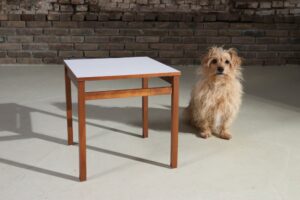
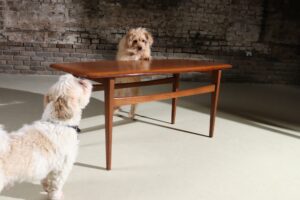
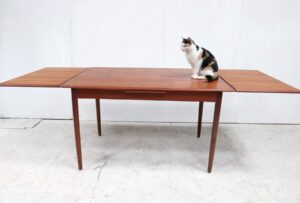
1955 Beautiful teak tea trolley / serving trolley, 1950s € 220 1965 Mid-Century Modern Magazine Rack, Teak and Chrome, 1960s € 90 1965 Vintage side table with white top € 145 1965 Vintage coffee table with curved top € 135 1965 Teak extending dining table in Danish style € 475Contemporary
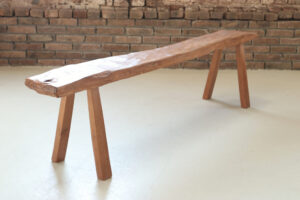
2010 Rustic teak bench made from a single plank € 245133 pieces in teak found a new home
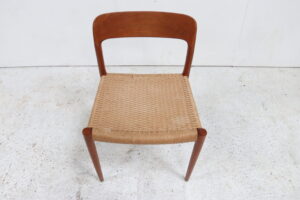 Niels O. Møller chair model 75Sold
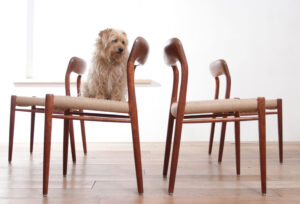 Set of 4 Niels Otto Møller model 75 dining chairsSold
 Sleek vintage design armchair in black skai and teak, 1960sSold
 Vintage design armchair teakSold
 Sustainability meets style: vintage highboard with teak veneerSold
 Vintage Design Teak Desk with 12 DrawersSold
 Mid-Century Pastoe Cees Braakman Made to Measure Teak CabinetSold
 3 x Niels O. Møller Model 84 Teak Bouclé Dining Chair for J.L. Møllers, 1976Sold
 Teak Pastoe Cees Braakman Desk 1960sSold
 Poul Cadovius Modular Floating Wall System Teak Denmark 1950’sSold
 Poul Cadovius Modular Floating Wall System Teak Denmark, 1950’sSold
 Poul Cadovius Modular Floating Wall System in Teak, Denmark, 1950’sSold
 Solid Teak Cadovius Style Wall System ca 1958Sold
 Poul Cadovius for Royal System Wall System in Teak, Denmark 1950’sSold
 Niels O. Møller Model 84 Teak Dining Chair for J.L. Møllers, 1976Sold
 Danish Midcentury Easy Chair Teak red Boucle Wool 1950’sSold
 Vintage Design Armchair Teak Turquoise 1960sSold
 Danish Design Grete Jalk Coffee Table, Model 622/54, Teak, France & Søn, 1960sSold
 Vintage Design Mimiset Teak Chrome 1960sSold
 Vintage Design Wall Coat Rack Chrome TeakSold
 Vintage Design Teak Sideboard 1960sSold
 Vintage Danish Design Footstool Ottoman Leather TeakSold
 Vintage Design Topform Chairs Black Skai TeakSold
 Vintage Design Teak Chairs Bi-Colour 1960sSold
Looking for something in teak?
Let us know. We buy every week and will tell you when something comes in. We ship worldwide.