

Wrought iron is iron shaped by hand. A smith heated it in the fire until it glowed and drew, bent and twisted it with the hammer, and you can always see that in it. It is in garden chairs and tables, lanterns, candlesticks, fire irons and gates. It is heavy, matt and honest, and it was made to last.
What it is
Wrought iron is almost pure iron. It contains less than 0.05 per cent carbon. That makes it tough and pliable: you can beat it into shape while it glows, and two pieces can be forged together in the fire. What it does contain is slag, up to two per cent. That slag runs through the iron in long threads and gives it a fibre, a little like the grain of wood. You see that fibre where old wrought iron has rusted or broken.
Wrought iron, cast iron and steel
The three are often confused, and the difference lies in the carbon. Cast iron contains more than two per cent carbon. It is melted and poured into a mould. That gives you an intricate shape in one go, and the same shape as often as you like. But cast iron is brittle: it does not bend, it breaks.
Steel sits in between. Ordinary mild steel contains about a quarter of a per cent of carbon. Much of what is sold as wrought iron today, such as garden furniture and gates, is in fact mild steel. The word has stayed for the work of the smith, even when the material changed.
Where it comes from
Forging is as old as iron itself. The smith heats the iron in a coal fire and hammers and bends it into shape. In 1784 the Englishman Henry Cort invented the puddling furnace. In it cast iron is melted and stirred until the carbon has burnt out. After 1800 that became the usual way of making wrought iron, and it became the iron of building. The Eiffel Tower of 1889 is made of such iron from the puddling furnace: 7,300 tonnes, held together by 2.5 million rivets.
By then the end was already in sight. Steel took over, and around 1890 it had largely replaced wrought iron in building. The last works closed in the 1970s. True wrought iron is no longer made on a large scale. So an old piece is also made of a material of which there will be no more.
The French ironwork of art deco
The great name is Edgar Brandt (1880–1960), born in Paris. He learned the trade at the technical school in Vierzon, where he finished in 1898, and opened a small workshop in Paris in 1901. Brandt did something the old smiths did not: he used the welding torch early on and let machines do part of the work, after which the hand finished it. In the 1920s he developed a stylised flower motif of his own.
In 1914 his ironwork for the Escalier Mollien in the Louvre was unveiled. In 1921 he made the metalwork at the Tomb of the Unknown Soldier beneath the Arc de Triomphe. In 1924 came the screen L’Oasis, and at the great exhibition of 1925 in Paris stood his gates for the Porte d’Honneur. That exhibition made him world-famous. With the Daum glassworks of Nancy he made lamps, such as La Tentation and Cobra.
Beside him stood Raymond Subes. In 1919 he became artistic director of the Borderel et Robert workshops in Paris and made ironwork for the great French ocean liners, among them the Normandie of 1935.
Dutch ironwork
In the Netherlands too the craft flourished in those years. From 1917 the architect Piet Kramer was aesthetic adviser for the bridges of Amsterdam. For his bridges he often designed the bridge keepers’ houses and the ironwork as well.
Willem Hendrik Gispen (1890–1981), later known for tubular steel, started in Rotterdam in 1916 as an art metalworker. His early work is ornamental ironwork in the spirit of the Amsterdam School, the Dutch expressionist style, and of art nouveau. In 1924 his firm made six wrought-iron chandeliers for a Rotterdam church.
French garden furniture
The French iron garden chair is a story of its own. In 1889 Édouard Leclerc was granted a patent for the Simplex, a folding chair of metal. It is the model for the bistro chair everyone knows. You find old French garden furniture in wrought iron and in cast iron, and a table often has a marble top. You can tell which of the two you have in front of you from the traces of the making.
How to recognise handwork, and cast iron
Forged work is never quite even. Look along a bar and run your hand over it: on the surface you see and feel the small flats left by the hammer. Two scrolls meant to mirror each other never quite do. That is not carelessness, that is the hand.
Then look at the joints. The smith assembles his work with rivets and with forge welds. In a forge weld two glowing pieces have been hammered into each other until they are one. You almost never find rivets in cast iron, because it is too brittle to drive them in. A torch weld does not tell you everything about age: Brandt already used it in his best work.
Cast iron comes out of a mould, and that mould leaves traces. Look for the casting seam: a fine line where the two halves of the mould met. Sometimes the halves have shifted a fraction and the pattern does not quite match. Here and there the surface has small pits and blowholes. Two cast parts are exactly alike, down to the smallest leaf.
Wrought iron has none of that. No seam, no blowholes, but hammer marks and rivets. A magnet does not help you here: wrought iron, cast iron and steel all attract it. The magnet is useful, though, for telling iron from brass or bronze under a coat of paint.
What to look for when you buy
Rust belongs to iron. A thin brown layer does no harm and is often rather beautiful. Look where water collects: at the foot of the legs, in the corners, between two bars lying against each other. There rust can have made the iron thinner. With cast iron, look for cracks and old repairs, because cast iron breaks where wrought iron bends. Look at the paint too: thick layers hide the hammer marks and the seams you are looking for.
Care in brief
Keep wrought iron dry and wipe it with a dry cloth. Bring garden furniture indoors in winter or put it in a dry place. You can read more in the book Caring for chrome and steel on the Care shelf.
Why we love it
Wrought iron draws a line in space. A candlestick, a lantern or a garden chair of old iron stands dark and matt against a pale wall, and at every bend you can see that someone stood over it with a hammer. It does not have to shine and it does not have to be straight. You will find the wrought-iron pieces from our collection below, and all of them already have a life behind them. We ship worldwide.
Written by De HuiszwaluwWrought iron
The Golden Age
Art deco
Mid-century
Postmodern
The Golden Age
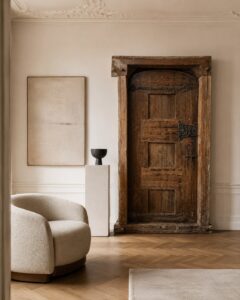
1675 Antique oak door with frame and ornate openwork wrought-iron lock € 3.995Art deco
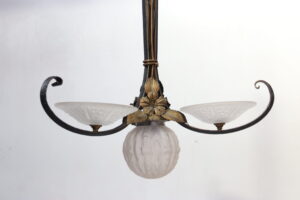
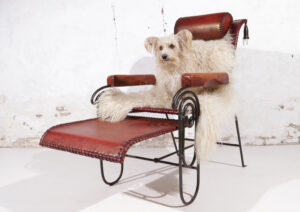
1920 French pendant lamp € 445 1930 French Art Deco lounge chair in wrought iron and leather with extendable footrest € 1.295Mid-century
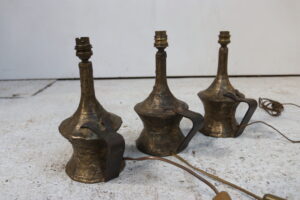
1965 Max Bré € 575Postmodern
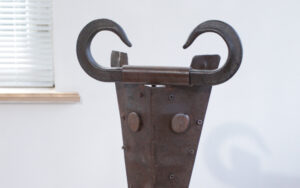
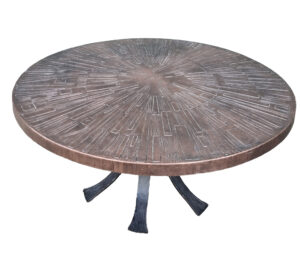
1975 Brutalist bull mask € 425 1975 Brutalist wrought-iron round coffee table with bronze-coloured top € 8955 pieces in wrought iron found a new home


Looking for something in wrought iron?
Let us know. We buy every week and will tell you when something comes in. We ship worldwide.