

Glass is the only material in the house that lets light through and shapes it at the same time. A vase, a decanter, the shade of a lamp: they all do something with the daylight that falls on them. Glass is also the material in which you can best see how it was made. If you know where to look, you can tell whether a glassblower had it on his pipe or whether it came out of a press.
What it is
Ordinary glass is 70 to 74 per cent sand, or to be precise silica. Soda is added so that it melts at a lower temperature, and lime, which makes the glass durable. This is called soda-lime glass.
Glassblowing is well over two thousand years old. In the middle of the first century BC craftsmen on the eastern shore of the Mediterranean, in what is now Lebanon and Israel, discovered that you can inflate a gather of hot glass on a pipe. Shortly afterwards, in the first century AD, glass was also blown into a mould.
Blown and pressed
In free blowing the glassblower shapes the bubble with his breath and his tools, without a mould. When the form is almost finished, a second iron rod, the pontil, takes over the piece at the base. That frees the top so the rim can be finished. Then the pontil is broken off.
Pressed glass is not blown. A gather of hot glass is pushed into a metal mould with a plunger. The technique was developed in America in the 1820s; in 1825 John Bakewell of Pittsburgh was granted the first patent for a pressing machine. In the 1830s pressing came to Europe, above all to France, Bohemia and Sweden. Between 1850 and 1910 most inexpensive household glass was pressed.
Crystal and opaline
Crystal is glass containing lead oxide. The Englishman George Ravenscroft was granted a patent in the 1670s and in the following years was the first to bring lead glass to market on a large scale. Lead makes glass heavier and makes it refract light more strongly, so that cut crystal sparkles like a prism. It is also softer, which makes cutting easier, and it gives a clear ring when you tap it gently.
Here is a rule you should know. In the European Union only glass with at least 24 per cent lead oxide may be called lead crystal; that is laid down in Directive 69/493/EEC. Glass with less lead is called crystalline or crystal glass. And there is a piece of advice that goes with the rule: lead can leach into drink, and more so the more acidic the drink is and the longer it stands. Use a crystal decanter for pouring and not for keeping drink in for months.
Opaline is milky, semi-translucent glass. It was made above all in France, in the nineteenth century, with a peak under Napoleon III. The great names are Baccarat, Saint-Louis and Le Creusot. In the original recipe bone ash was added to the crystal. True old opaline is mouth-blown: it has no seams and a pontil mark on the base, rough or ground away.
Dutch glass: Leerdam and Copier
In 1912 the Glasfabriek Leerdam, the glassworks in the Dutch town of Leerdam, was given a director who wanted to make art of glass, P.M. Cochius. In 1915 the architect K.P.C. de Bazel was the first to design glass services, and after him came H.P. Berlage, Chris Lanooy, Cornelis de Lorm and Chris Lebeau, among others.
The most important name is Andries Dirk Copier (1901–1991). He entered the factory as a boy in 1914 and stayed until 1971. From 1927 he was its artistic director. In 1930 he designed the Gildeglas, which is still made today. Alongside it he made Unica: free pieces of which only one exists, signed and numbered with the diamond point. Serica are small series, often after a successful unique piece. In 1940 he founded the Glasschool, the glass school, in Leerdam.
Murano, Scandinavia and France
In Venice the furnaces have stood on the island of Murano since a law of 8 November 1291. There Angelo Barovier developed cristallo around 1450, a colourless glass named after rock crystal. Murano is famous for millefiori and filigree, and from the twentieth century for sommerso, Italian for submerged. That technique dates from the late 1930s. Flavio Poli was known for it, and in the 1950s Seguso Vetri d’Arte made it popular.
In Sweden Orrefors began in 1898 as a factory for bottles and window glass. With the artists Simon Gate, from 1916, and Edward Hald, from 1917, it became one of the great names, admired at the exhibition of 1925 in Paris. In Finland Iittala has existed since 1881. Alvar Aalto designed his undulating vase there in 1936, and in 1951 Tapio Wirkkala and Timo Sarpaneva won prizes at the Milan Triennale. In Denmark Per Lütken was artistic director of Holmegaard from 1942 until his death in 1998.
The French glass of art deco bears the name of René Lalique (1860–1945). He began as a jeweller, designed perfume bottles from 1907 and opened a glassworks at Wingen-sur-Moder in Alsace in 1921. In Nancy the Daum glassworks had been at work since 1878.
Glass in lamps
Glass and light belong together. A shade of opaline or frosted glass spreads the light and hides the light source. Daum made lamps with the smith Edgar Brandt in which glass and metal come together. So with an old lamp, look at the glass first: check that the shade is whole and that it belongs to the base.
How to recognise blown glass and pressed glass
Turn the piece over. On the base of free-blown glass you find the pontil mark, the scar where the rod was broken off. Often it has been ground away to a smooth, hollow circle. The absence of a mark does not necessarily mean the piece is pressed: it can also have been blown into a mould, or the mark has been ground completely flat.
Then hold it up to the light. Blown glass is never quite even. The wall is a little thicker in one place than in another, the shape is not quite symmetrical, and you see small air bubbles and fine streaks in the glass. Air bubbles alone prove nothing; they occur in pressed glass too. So always look at more than one feature.
Pressed glass comes out of a mould made of parts, and where those parts meet a seam is left. Feel along the side with your fingertip: you find a fine raised line, often in two or three places. The wall is equally thick everywhere and two pieces are exactly alike. In good pressed glass the seams are almost hidden, so look in the pattern and under the foot as well.
What to look for when you buy
Run your finger along the rim and the foot. You feel a chip before you see it. Hold the glass up to the light and look for cracks, especially near a handle or a spout.
Care in brief
Wash old glass by hand in lukewarm water and dry it with a soft cloth. Do not put it in the dishwasher. You can read more in the book Caring for glass, ceramics and porcelain on the Care shelf.
Why we love it
Glass asks for almost nothing and gives a great deal. One blown vase on a windowsill, without flowers, catches the cool daylight and lays a patch of colour on the white wall. It is the small irregularities, a bubble, a wall that is not equally thick everywhere, that make the light come alive in it. You will find the glass pieces from our collection below, and all of them already have a life behind them. We ship worldwide.
Written by De HuiszwaluwGlass
Empire & Napoleon III
Art nouveau
Art deco
 c. 1920–1935
French pendant lamp
€ 445
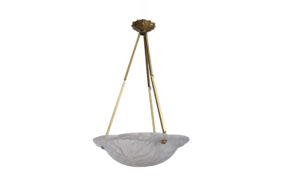 1920s–30s
Art Deco pendant lamp by Degué
€ 395
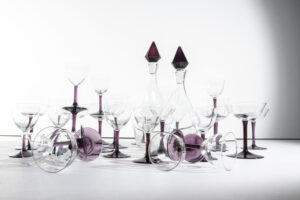 1929
26-piece glass service Logos & Narkissos by W.J. Rozendaal
€ 695
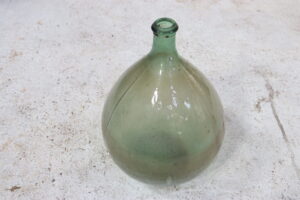 c. 1930–1960
Green glass demijohn
€ 85
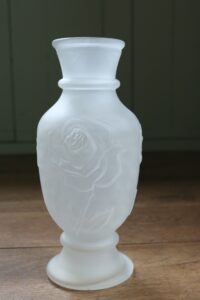 c. 1930–1960
Frosted pressed glass vase with relief roses
€ 65
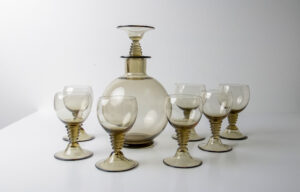 1932–1933
Art Deco Traditie decanter with 7 glasses by W.J. Rozendaal
€ 195
 1932–1933
Set of 7 Art Deco “Traditie” W.J. Rozendaal 1932–33 Decanter and 6 Glasses
€ 155
Mid-century
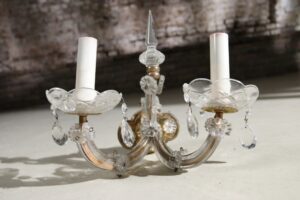 mid-20th century
Crystal Wall Sconce in Maria Theresa Style
€ 65
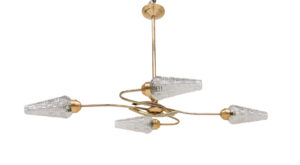 1950s–60s
Vintage brass pendant lamp with four glass shades
€ 325
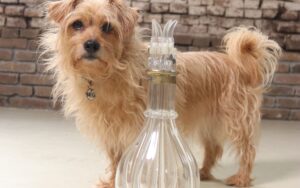 1950s–1970s
French decanter with 4 compartments
€ 45
 c. 1960–1970
Set of 2 vintage Hiemstra Evolux pendant lamps
€ 395
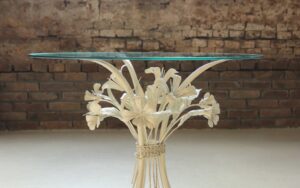 1960s–1970s
Side table with metal lilies and glass top
€ 275
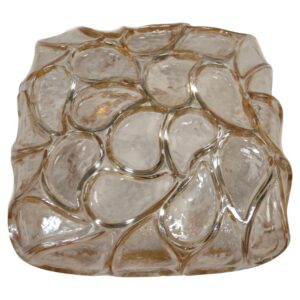 1960s
Glass ceiling lamp by Glashütte Limburg
€ 195
 1968
Vintage glass fish sculpture
€ 75
Postmodern

Contemporary

Timeless

Empire & Napoleon III
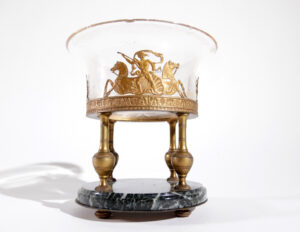
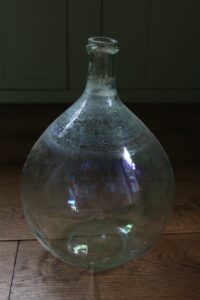
1825 Empire tazza in fire-gilt bronze, marble and glass € 845 1850 French demijohn in mouth-blown glass with iridescent patina € 120Art nouveau
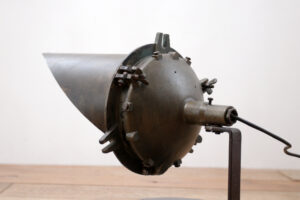
1900 Antique bronze lock lamp with red signal glass € 395Art deco
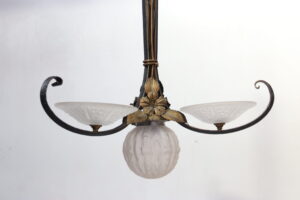
1920 French pendant lamp € 445 1925 Art Deco pendant lamp by Degué € 395 1929 26-piece glass service Logos & Narkissos by W.J. Rozendaal € 695 1930 Green glass demijohn € 85 1930 Frosted pressed glass vase with relief roses € 65 1932 Art Deco Traditie decanter with 7 glasses by W.J. Rozendaal € 195 1932 Set of 7 Art Deco “Traditie” W.J. Rozendaal 1932–33 Decanter and 6 Glasses € 155Mid-century
1950 Crystal Wall Sconce in Maria Theresa Style € 65 1955 Vintage brass pendant lamp with four glass shades € 325 1955 French decanter with 4 compartments € 45 1960 Set of 2 vintage Hiemstra Evolux pendant lamps € 395 1965 Side table with metal lilies and glass top € 275 1965 Glass ceiling lamp by Glashütte Limburg € 195 1968 Vintage glass fish sculpture € 75Postmodern
1975 Temde table lamp with opaline glass shade and stainless steel base € 295 1985 Vintage serving trolley in Bauhaus style with glass top € 445 1985 Large Dutch Design Vilma Henkelman Unica Leerdam Art Glass Vase, 1989 € 395Contemporary
2002 Unica design thick-walled vase by Roel Olivier, Leerdam glass € 130Timeless
Ceramic / glass sculpture bowl with monogram € 10050 pieces in glass found a new home
 Gallotti & Radice “Riki T52” Chrome & Glass Serving Trolley / Bar Cart, ItalySold
 Vintage cabinet / small sideboard with textured glass sliding doorsSold
 Set of 2 vintage cabinets with reeded glassSold
 Vintage oak school cabinet display cabinet with glass doorsSold
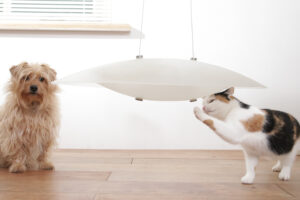 Design UFO pendant lamp, bowl shape, diffuse light, frosted glassSold
 Vintage 1970s Plexiglas nesting tables by Roche Bobois, designed by Michel DumasSold
 Space age Plexiglas coffee table with smoked glass top ’70Sold
 Decorative mirror, gold and “old” glassSold
 Vintage Design Coffee Table Tiles Smoked Glass Chrome 1970sSold
 Art Deco Design Side Table Tortoiseshell Glass Chrome RimSold
 Large 80’s Chandelier Hose Glass MetalSold
 Side Tables Nesting Tables Tubular Frame Chrome Smoked Glass 1960sSold
 Vintage Design Pendant Lamp, Yellow GlassSold
 Art Deco / Bauhaus Design Trolley, Glass ChromeSold
 Large Art Nouveau Mirror, Original Antique GlassSold
 Vintage Design Pendant Lamp, Black Metal GlassSold
 Boho Rattan Newspaper Table, Ice Glass, 1960sSold
 Hollywood Regency Style Pendant Lamp, Gold and GlassSold
 Dutch Design Dijkstra Hollywood Regency Style Wall Lamp, Gold / GlassSold
 Post Modern Glashütte Limburg German Table or Floor Lamp, 1970sSold
 Vintage Design Glass Table Lamp, 1960sSold
 Vintage (Wall) Cabinet with Glass Doors, 1950sSold
 Design Bijenkorf Hand Stool, FibreglassSold
 Vintage design Italian Murano glass table lampSold
Looking for something in glass?
Let us know. We buy every week and will tell you when something comes in. We ship worldwide.