

Bamboo looks like wood and is used like wood, but it is a grass. The stem is hollow, light and surprisingly strong. In Asia furniture has been made from it for a very long time. In Europe bamboo became a great fashion twice: at the end of the nineteenth century, when everyone wanted something from the Far East at home, and again in the 1960s and 1970s. In between, and alongside, it has been imitated endlessly in ordinary wood.
What it is
Bamboos form a subfamily of their own, the Bambusoideae, within the grass family Poaceae. There are more than 1,400 species in 115 genera. Most grow in warm, moist regions, in the tropics and in areas with a warm temperate climate.
A bamboo stem consists of internodes and nodes. The internodes, the sections between the nodes, are hollow in most species. A tree grows thicker every year; bamboo does not. The stem comes out of the ground at its full thickness and does not grow any thicker after that. Bamboo is among the fastest-growing plants in the world: some species grow 91 centimetres in twenty-four hours.
Like wood, bamboo is naturally strong for its weight. That makes it suitable for a frame: you can lift a small bamboo table or rack with two fingers.
The East and the first imitations
In China bamboo furniture is a style of its own with a tradition going back thousands of years. In Europe it was first known mainly from pictures and from what the trade with Asia brought back. Anyone who wanted to follow the taste had it imitated.
The most famous example is in England. For the Royal Pavilion in Brighton, the pleasure palace of the future King George IV, furniture was made of beech carved and painted to look like bamboo, with panels of woven rattan. In the palace library there are still two bookcases of this imitation bamboo.
The nineteenth century: the fashion for Japan
In the second half of the nineteenth century Japan opened to trade and Europe fell under the spell of everything Japanese. The British came to know it at the International Exhibition of 1862 in London, where Sir Rutherford Alcock, the British envoy to Japan, showed a collection of Japanese art.
Bamboo furniture followed. English manufacturers, chiefly in London and Birmingham, made small tables, étagères, hall stands and cabinets from imported bamboo, often with a top or panel of lacquer.
In Paris it was Perret et Vibert. The house was founded in 1872 and stood in the rue du Quatre-Septembre. It made armchairs, chairs and sofas of bamboo, rattan and wicker, also sold furniture from Japan and India, and won two gold medals at the Universal Exhibition of 1889. Later it called itself the Maison des Bambous. Like most fashions this one passed too, and bamboo fell out of favour.
Imitation bamboo: faux bamboo
Alongside real bamboo the imitation lived on. Imitation bamboo, known in the trade as faux bamboo, is ordinary wood that has been given rings on the lathe to look like nodes. British makers often used beech for it; American makers preferred maple.
Faux bamboo is not a lesser kind. It is solid wood, and you will find large pieces of furniture in it too, such as beds and desks. It is simply something other than bamboo, and that ought to be stated honestly.
The 1960s and 1970s
In the 1960s and 1970s bamboo returned, this time together with rattan. The Milanese designer Gabriella Crespi (1922–2017) drew a whole collection in bamboo and rattan between 1972 and 1975: rattan was in fashion in her circles, and she liked the material because it is strong and can be used for many things. Much of the bamboo you find today comes from those years.
Bamboo or rattan
The two are constantly mixed up, and they are often found together in one piece of furniture. The difference is simple. Bamboo is a grass with a hollow stem. Rattan is the stem of a climbing palm and is solid. Rattan bends well and is used for the round shapes, and its outer layer serves as binding around the joints. Rattan has a book of its own on this shelf.
How to recognise real bamboo
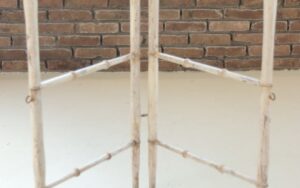
Look at the nodes first. On real bamboo they are never exactly the same distance apart and no node is like another. On faux bamboo the rings are turned: they are all the same and evenly spaced.
Then look at an end, under a leg or at the back. Real bamboo is hollow. Faux bamboo is solid and you can see the grain of the wood. Finally, lift the piece. Real bamboo is much lighter than you expect; faux bamboo weighs what a wooden piece of furniture weighs.
What to look for when you buy
Bamboo can split lengthwise. That is caused by changes in humidity, and it usually starts at a node. A fine crack in one internode is a blemish. A leg that gapes along its whole length no longer bears weight.
Look also for small round holes with fine powder beneath them. Bamboo contains a great deal of starch and so attracts a beetle, Dinoderus minutus, which attacks dried bamboo in particular. Fresh powder means it is still inside. Feel, too, whether the joints are firm and whether the binding is coming loose anywhere. On lacquer panels, check that the lacquer is not flaking.
Care in brief
Do not put bamboo beside a radiator or in full sun: dryness and rapid changes make it split. Dust it with a soft brush and use little water. There is more in the book Caring for rattan and cane on the Care shelf.
Why we love it
Bamboo is light and airy, and it brings something of the outdoors inside. A small bamboo table beside a plain sofa or under a window loosens a room without filling it. The colour is warm and matt, and the nodes give each piece a rhythm of its own. You will find the pieces of bamboo and of faux bamboo from our collection below, and every one of them already has a life behind it. We ship worldwide.
Written by De HuiszwaluwBamboo
The eighteenth century
Art nouveau
Timeless
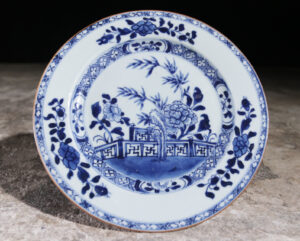
The eighteenth century
1736 Chinese blue and white plate with garden fence, peony and bamboo € 160Art nouveau
1900 Faux bamboo towel rail € 95Timeless
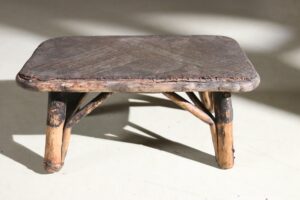
Small Old Bamboo Footstool with Leather Top € 1359 pieces in bamboo found a new home
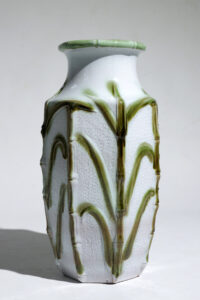 Large Carstens ceramic vase with bamboo decorationSold
 Vintage Design Bamboo Bohemian Brutalist Harness Leather Armchair 1970sSold
 Vintage Boho Design Bamboo Coffee Table, 1980sSold
 Italian Faux Bamboo Design Giorgetti ChairSold
 Eclectic Design Painting, Bamboo, EgretsSold
 Vintage Maison Jansen Style Bamboo Side TableSold
 Retro Vintage Side Table, Bamboo, Yellow, Round Shapes, 1960sSold
 Retro Vintage Bamboo Lounge Set, Small Armchairs & Table, 1950sSold
 Charming Retro Vintage Bamboo Bistro Table, 1950sSold
Looking for something in bamboo?
Let us know. We buy every week and will tell you when something comes in. We ship worldwide.