

A chair of bent tubular steel is light, strong and almost transparent in a room. It gleams because of a layer of chrome thinner than you can imagine. Chrome and tubular steel have belonged together since the 1920s, when a few young designers reinvented furniture. Once you learn to read old chrome, the shine tells you how old a piece is.
What it is
Chromium is a hard, steel-grey metal that has a high shine and does not tarnish. The Frenchman Louis Nicolas Vauquelin first isolated it in 1797. The name comes from the Greek word for colour, because the compounds of chromium are so brightly coloured. In the air the metal forms an invisibly thin layer of oxide of its own accord, and that protects it.
A chrome-plated chair is not made of chrome. It is made of steel, and the chrome has been deposited on it in a bath with electric current. The decorative layer is usually 0.13 to 0.25 thousandths of a millimetre thick. Beneath it lies a thicker layer of nickel, and in the best work a layer of copper beneath that. The nickel makes the chrome adhere well and last longer; the chrome keeps the nickel from tarnishing.
First nickel, then chrome
Nickel plating is the older technique. The first practical recipe is Rudolf Böttger’s, from 1843, and until the 1920s nickel was the usual bright finish for metal. Chromium was used to coat metal as early as 1848, but only after an improved process of 1924 did chrome plating become common.
That year is useful to remember. The first tubular steel furniture, from the late 1920s, is often still nickel-plated. After that chrome wins out, and nickel disappears beneath the chrome as an underlayer.
Marcel Breuer and the bicycle
In 1925 Marcel Breuer, head of the furniture workshop at the Bauhaus in Dessau, bought his first bicycle. The light frame of tubular steel gave him an idea. In 1925 and 1926 he designed a club armchair of bent tube with tightly stretched straps of Eisengarn, iron yarn, a strong waxed cotton thread. The chair was called model B3. The first examples were nickel-plated.
The chair was given the name Wassily only much later. In 1962 the Italian manufacturer Gavina reissued it, now with straps of black leather, and named it after the painter Wassily Kandinsky, who had praised the chair in 1925. In 1968 Knoll took over the Gavina company.
Mart Stam and the chair without back legs
Mart Stam was born in 1899 in Purmerend, a town north of Amsterdam. He thought up a chair that rests on one continuous tube and has no back legs. On 22 November 1926 he sketched the idea during a dinner in Stuttgart, on the back of a wedding invitation. In 1927 he showed the chair in his house on the Weissenhof estate in Stuttgart, the exhibition where modern architecture presented itself.
At the same exhibition Ludwig Mies van der Rohe showed his own version, the MR10. Breuer followed with his own chairs without back legs. Who had been first became a matter for the courts. In 1932 German judges ruled that Stam was the designer.
Thonet and Gispen
Thonet, the factory of the bentwood café chair, saw what was happening. In 1928 the company signed an agreement with Breuer and in 1929 it took over his firm Standard-Möbel. The catalogue of 1930 contained tubular steel furniture by Breuer, Stam, Mies van der Rohe, Le Corbusier and the Luckhardt brothers.
In the Netherlands Gispen did the same. Willem Hendrik Gispen (1890–1981) started an art metalwork shop in Rotterdam in 1916. In 1926 his Giso lamps came on the market, and in November 1927 he showed his first chair of tubular steel. From 1929 the factory made furniture in series. In 1934 Gispen moved to Culemborg, in the middle of the country, and in the same year the armchair 412 appeared, which was made until 1966. In the 1930s Gispen and Thonet also went to court over Stam’s chair.
The return in the 1960s and 1970s
Tubular steel came back in the 1960s. Gavina’s reissue of the Wassily in 1962 was a beginning, and in 1968 Gavina passed into the hands of the American firm Knoll. With those reissues chrome-plated tubular furniture came into the home again in the 1960s and 1970s. So a Wassily with black leather straps is a chair from that second wave, not from the 1920s: the first had straps of fabric.
How to recognise old chrome and nickel
If you can, put two pieces side by side. Chrome has a cool, faintly blue cast. Nickel is warmer and leans towards yellow. The difference is small and you only see it properly by comparison, in daylight.
Ageing tells you more. Nickel tarnishes: it goes dull and yellowish. Chrome itself stays bright, but it pits, and in such a pit rust from the steel comes to the surface. Where the chrome has gone, you see the slightly yellower layer of nickel beneath. A magnet sticks to the tube, because it is steel.
Look at how the frame is made too. Breuer’s early B3 is screwed together. And look at the covering: straps of fabric belong to the 1920s, black leather to the reissue.
What to look for when you buy
Check the whole frame for pits and rust spots, low down and at the back as well. A few spots come with age. Deep rust and flaking chrome are another story, because the layer is too thin to touch up. Re-plating is possible, but then the old skin is gone.
Is there anything you should know about rules? Chrome plating in the factory uses toxic chromium compounds, and in Europe those are bound by strict rules. The layer on your chair is metallic chromium, and that is regarded as non-toxic.
Care in brief
Wipe chrome with a soft, slightly damp cloth and rub it dry. Do not use an abrasive: the layer is too thin. You can read more in the book Caring for chrome and steel on the Care shelf.
Why we love it
A chair of tubular steel takes up almost no space. You look through it to the floor and the wall, and that keeps a room light and calm. We love chrome and nickel most when they no longer shine like a mirror but have grown soft, a little matt, with life in it. You will find the pieces in chrome and tubular steel from our collection below, and all of them already have a life behind them. We ship worldwide.
Written by De HuiszwaluwChrome
Art deco

Mid-century


Postmodern


Art deco
1935 1930s Extremely Rare Art Deco Black Bakelite and Chrome Umbrella Stand € 395Mid-century
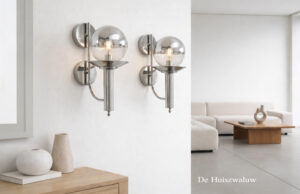
1965 Vintage Soudeurop kitchen chair € 20 1965 Pair of European Mid-Century Chrome Wall Sconces with Mirrored Globe Shades, circa 1960s–1970s € 295 1965 Mid-Century Modern Magazine Rack, Teak and Chrome, 1960s € 90Postmodern
1970 Hollywood Regency Italian Coffee Table by Renato Zevi, 1970, Chrome € 375 1975 Mid-Century Design 5-Arm Gaetano Sciolari Ceiling Lamp / Chandelier, Chrome € 345 1992 Jimmy Car Katwijk chairs, mint green and chrome, Sept. 1992 € 4576 pieces in chrome found a new home
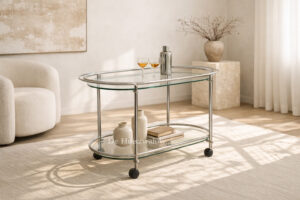 Gallotti & Radice “Riki T52” Chrome & Glass Serving Trolley / Bar Cart, ItalySold
 Vintage Design Armchair White Leather / ChromeSold
 Vintage Design Folding Serving Trolley Tea Trolley White / ChromeSold
 Vintage Design Bedside Tables Green with ChromeSold
 Industrial Vintage Gijs van der Sluis School Chairs ChromeSold
 Vintage Design Nesting Tables Mimiset Rosewood ChromeSold
 Vintage Design Desk Lamp Chrome Black and Wenge 1960sSold
 Vintage Design Coffee Table Tiles Smoked Glass Chrome 1970sSold
 4 Vintage Design Tubular Frame Dining Chairs Chrome 1970sSold
 Art Deco Design Side Table Tortoiseshell Glass Chrome RimSold
 Italian 1980s Design Armchair, Tubular Chrome Steel and Black LeatherSold
 Vintage Design Wall Rack Black Chrome ’80Sold
 Vintage Design Mimiset Teak Chrome 1960sSold
 4 Italian Design Harness Leather Chrome Tubular Frame Chairs 1980sSold
 Vintage Design Wall Coat Rack Chrome TeakSold
 Vintage Design 80’s Stylish Wire Steel Chairs Chrome Black LeatherSold
 5 “Jim” Design Chairs Chrome and Black Shell 1990s by Wim Marseille for KensSold
 Vintage Design Standing Coat Rack Chrome 6 HooksSold
 Vintage Design Kusch & Co Chairs Chrome ShellSold
 Side Tables Nesting Tables Tubular Frame Chrome Smoked Glass 1960sSold
 Art Deco / Bauhaus Design Trolley, Glass ChromeSold
 Vintage Design Presikhaaf Chairs, Chrome Pagholz, LinkableSold
 Industrial Vintage Gijs van der Sluis School Chairs, Chrome, ArmrestSold
 Vintage Design 70’s Luxury Table Lamp, Black ChromeSold
Looking for something in chrome?
Let us know. We buy every week and will tell you when something comes in. We ship worldwide.