

Oak is the oldest furniture wood of our part of the world. Your great-grandmother’s cupboard is made of it, the church pew, the refectory table, and the sleek cabinet of 1950 as well. It is hard, heavy and honest: you see the grain, you feel the pores. Oak can last for centuries, and that is exactly what it has done.
What oak is and where it comes from
European oak comes from two trees: the pedunculate oak (Quercus robur) and the sessile oak (Quercus petraea). They grow in almost all of Europe, as far as Asia Minor and North Africa. The heartwood is light to medium brown, often with an olive cast. The grain is straight, the texture coarse. Oak is ring-porous: each spring the tree forms a row of large pores, and you see them in the wood as open little lines. Dried, it weighs about 675 kilos per cubic metre.
Oak contains a great deal of tannin. That makes the wood special, and it explains almost everything you later see happen to it. Where oak touches iron, it turns blue-black. With copper or brass it turns light brown.
Quarter-sawn: the ray fleck
In every oak, medullary rays run from the heart to the bark. If you saw a board at right angles to the growth rings, you cut those rays lengthwise and they come to the surface as gleaming flecks and bands. The Dutch call them spiegels, mirrors. This is called quarter-sawing, because the log is first divided into four quarters.
Quarter-sawn oak is not only more beautiful. It warps less and shrinks more evenly than plain-sawn wood. It does yield narrower boards and more waste, so it was always more expensive. In Dutch, oak of this quality has long been called wagenschot, wainscot oak. You see it where the wood is meant to be seen, as in the panelling of houses and ships.
The wood of the old cupboard
In Europe oak has long been the wood for furniture and carving. Since the Middle Ages it has also been the wood of church roofs, farmhouse frames, doors and stairs. Painters used oak panels. Because the growth rings of oak have been charted so well, those panels can often be dated to the year.
In the Dutch towns oak belonged to the cabinetmaker’s trade. The cheaper furniture of softwood, which was painted, came from other workshops. That is why many antique Dutch cupboards are oak.
Arts and Crafts and the Amsterdam School
At the end of the nineteenth century the furniture makers of the Arts and Crafts movement chose oak again, visible and unadorned. The American Gustav Stickley (1858–1942) made it his trademark. From 1901 his workshop supplied furniture of quarter-sawn white oak fumed with ammonia, and in the same year he started the magazine The Craftsman, which appeared until 1916. Cheap imitations were made of stained ash. You recognise them because the ray fleck is missing.
In the Netherlands the architects of the Amsterdam School, between about 1910 and 1930, also designed furniture, clocks and lamps. Michel de Klerk and Piet Kramer were the most important architects. The Rijksmuseum holds a suite of furniture by De Klerk of 1917–1918, with carved heads of turtles and frogs. The furniture factory ’t Woonhuys in Amsterdam sold his designs. Furniture in this style is heavy and sturdy, and much of it is oak.
After the war oak stayed. Pastoe in Utrecht produced an oak series from 1948 to 1959, designed by Cees Braakman. And while Finn Juhl chose teak, many other Danish designers of those years worked in oak.
Fumed, lye-treated and natural
Fumed oak is not stained. The wood is placed in a sealed space with a tray of strong ammonia. The fumes react with the tannin and turn the wood dark brown, to a little way below the surface. The discovery is English: oak boards in a stable darkened from the ammonia in the horses’ urine. Fuming does not hide the grain, as stain does, and the colour does not fade. Each board does come out slightly differently.
Lye-treated oak, gelogen eiken in Dutch, has been treated with ammonia or another alkali. It works in the same way: the alkali reacts with the tannin and the wood darkens. Natural oak, blank eiken, has had no colour treatment. It has only been finished with wax, oil or clear lacquer and keeps its own light brown colour.
Besides European oak there is American oak. White oak is lighter in colour. Red oak is pinker and softer and has a coarser grain.
How to recognise oak
Look for the ray fleck. No other common furniture wood shows it so clearly. On a quarter-sawn surface you see gleaming flecks lying across the grain. On a plain-sawn surface you see flames: broad arches of open pores.
Run your nail over the wood: you feel the pores as little grooves. Lift a drawer or a chair. Oak is heavy. Look at old iron fittings, nails and hinges: a blue-black ring in the wood around them is the tannin that has reacted with the iron. That is a good sign of real oak, and of age.
To find out whether a dark piece is fumed or stained, look for a spot of damage. In fumed wood the wood is brown below the surface too. With stain, pale wood appears.
What to look for when you buy a piece
Solid oak moves. See whether panels and tops have split or warped, and whether doors and drawers still close properly. With veneered oak, which is common in furniture, check the edges for veneer that is lifting.
Look at the legs: check that they are firm, and that they have not rotted or been spliced at the bottom. Look for woodworm holes and tap the wood; fresh bore dust means the worm is still alive. If one door or drawer differs from the rest in colour or in ray fleck, something has been replaced. That need not be a drawback, as long as you know.
Care in brief
Dust with a dry cloth and keep oak away from wet iron objects: a tin or a nail leaves a black ring. Waxed oak asks for a thin coat of wax polish now and then. You can read more in the book Caring for wood on the Care shelf.
Why we love it
Oak brings calm. It is matt, it is heavy, it stands. A dark fumed cupboard against a limewashed wall is enough to give a room a focal point. Natural oak does the opposite: it catches the cool daylight and makes a room light. And everywhere you see the hand of time: rounded corners, a top worn smooth, ray fleck that lights up when the sun brushes past.
You will find the oak pieces from our collection below. Every one of them already has a life behind it. We ship worldwide.
Written by De HuiszwaluwOak
The Golden Age
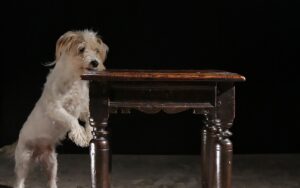 17th century
17th-century oak joint stool with turned legs
€ 1.450
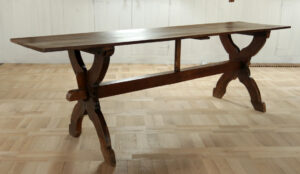 17th century (with 19th-century restorations)
17th-century French oak monastery table / trestle table
€ 4.295
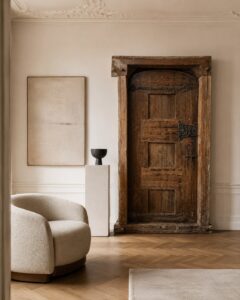 door 16th–17th century (construction in the late Gothic/Rena
Antique oak door with frame and ornate openwork wrought-iron lock
€ 3.995
The eighteenth century
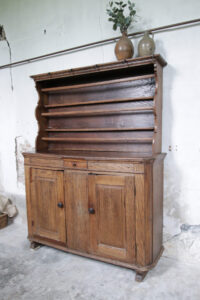 circa 1700
Antique Dutch oak pewter cupboard
€ 3.295
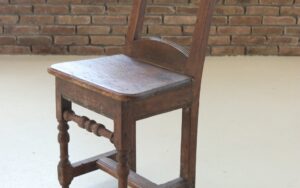 late 17th – early 18th century
French provincial oak chair from Lorraine
€ 245
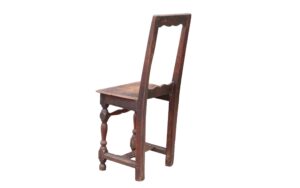 late 17th – early 18th century
French provincial oak chair from Lorraine
€ 245
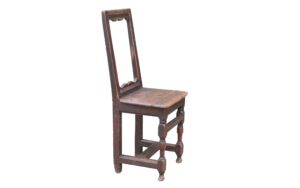 late 17th – early 18th century
French provincial oak chair from Lorraine
€ 245
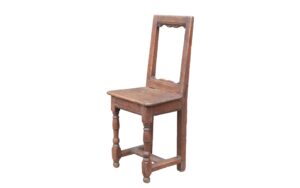 late 17th – early 18th century
French provincial oak chair from Lorraine
€ 245
Empire & Napoleon III
Art nouveau

Art deco
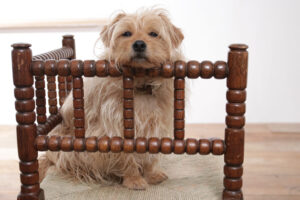 early 20th century
Antique Dutch oak corner chair with turned spindles and new rush seat
€ 295
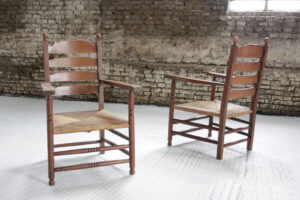 1930s
2 minimalist Dutch oak ladder-back armchairs with rush seats
€ 350
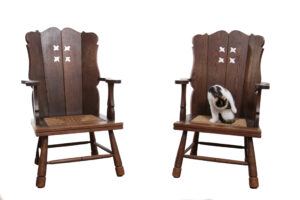 circa 1935
2 Brutalist oak lounge chairs with rush seats, circa 1935
€ 645
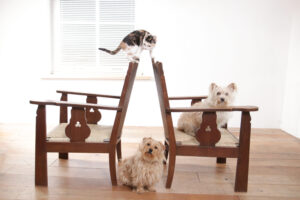 circa 1935
Pair of low Brutalist oak lounge chairs with new rush seats
€ 745
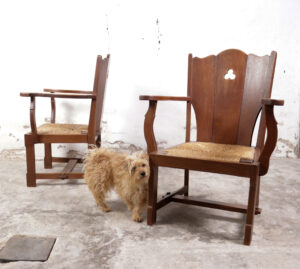 circa 1935
Pair of Brutalist oak lounge chairs with rush seats
€ 395
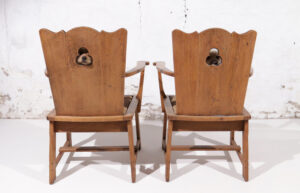 1930s
Pair of Brutalist oak throne chairs with rush seats
€ 595
Mid-century
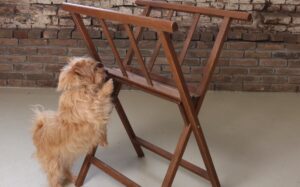 mid-20th century
Folding oak magazine rack with slats
€ 165
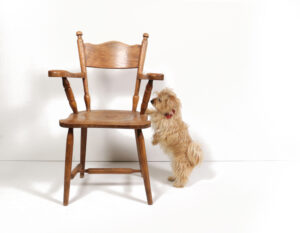 1950
Brutalist oak fireside chair
€ 245
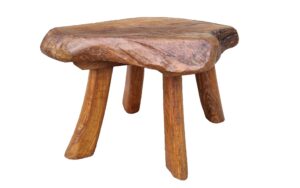 1950s
Mid-century hand-carved oak stool with live edge
€ 245
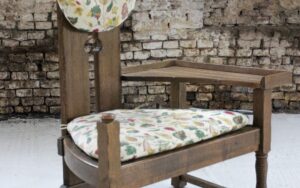 1950s
Rare Dutch Brutalist oak armchair with integrated side table
€ 595
 1950s
Dutch oak ladder-back armchair with rush seat
€ 195
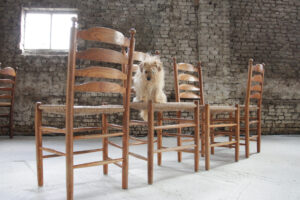 1960s
Set of 4 old Dutch oak ladder-back chairs with rush seats
€ 495
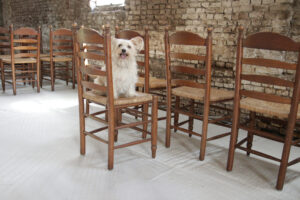 1960s
Old Dutch oak ladder-back dining chairs with rush seats
€ 145
 1960s
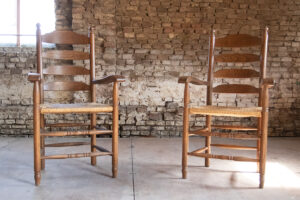
2 Dutch oak ladder-back armchairs with rush seats
€ 395
Postmodern

Contemporary

The Golden Age
1650 17th-century oak joint stool with turned legs € 1.450 1650 17th-century French oak monastery table / trestle table € 4.295 1675 Antique oak door with frame and ornate openwork wrought-iron lock € 3.995The eighteenth century
1700 Antique Dutch oak pewter cupboard € 3.295 1725 French provincial oak chair from Lorraine € 245 1725 French provincial oak chair from Lorraine € 245 1725 French provincial oak chair from Lorraine € 245 1725 French provincial oak chair from Lorraine € 245Empire & Napoleon III
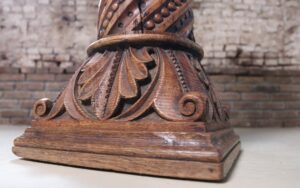
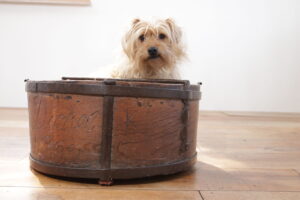
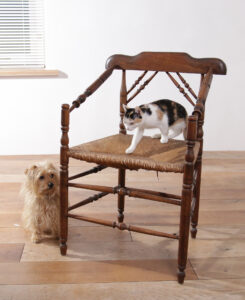
1850 Carved oak column with twisted shaft, beaded borders and acanthus base € 450 1850 Antique oak grain measure with iron mounts € 295 1850 Rare antique Dutch oak armchair with rush seat € 345Art nouveau
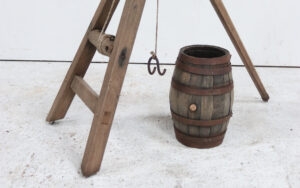
1900 Antique French oak barrel hoist with pulley, hook and small cask € 180 1910 French oak card index cabinet with four drawers € 275Art deco
1925 Antique Dutch oak corner chair with turned spindles and new rush seat € 295 1935 2 minimalist Dutch oak ladder-back armchairs with rush seats € 350 1935 2 Brutalist oak lounge chairs with rush seats, circa 1935 € 645 1935 Pair of low Brutalist oak lounge chairs with new rush seats € 745 1935 Pair of Brutalist oak lounge chairs with rush seats € 395 1935 Pair of Brutalist oak throne chairs with rush seats € 595Mid-century
1950 Folding oak magazine rack with slats € 165 1950 Brutalist oak fireside chair € 245 1955 Mid-century hand-carved oak stool with live edge € 245 1955 Rare Dutch Brutalist oak armchair with integrated side table € 595 1955 Dutch oak ladder-back armchair with rush seat € 195 1965 Set of 4 old Dutch oak ladder-back chairs with rush seats € 495 1965 Old Dutch oak ladder-back dining chairs with rush seats € 145 1965 2 Dutch oak ladder-back armchairs with rush seats € 395Postmodern
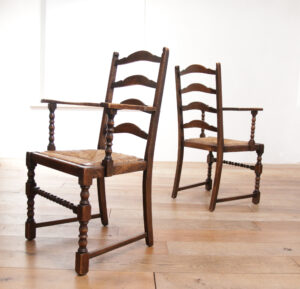
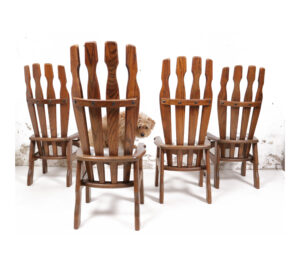
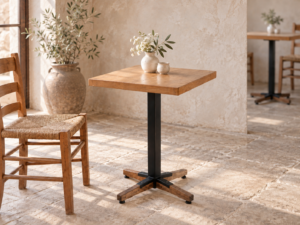
1975 2 English oak armchairs with ladder back and rush seats € 445 1975 Set of 4 Brutalist oak dining chairs with bouclé seats € 795 1975 Set of 4 Brutalist oak ladder-back dining chairs € 895 1980 4 vintage oak café tables / bistro tables € 75Contemporary
2020 French-style folding tables, bistro tables, terrace tables € 25020 pieces in oak found a new home
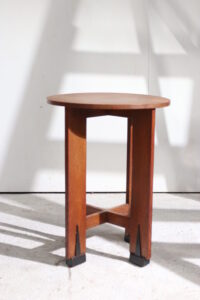 Round oak side tableSold
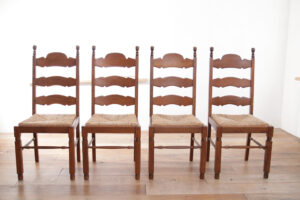 Set of 4 oak ladder-back dining chairs with rush seatsSold
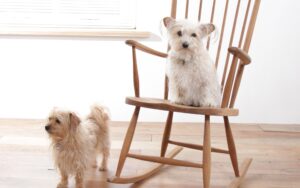 Scandinavian mid-century oak rocking chairSold
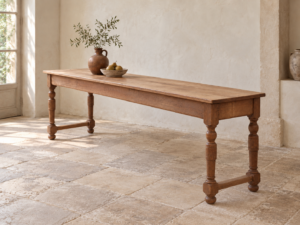 Long old oak table with turned legsSold
 Vintage oak school cabinet display cabinet with glass doorsSold
 Rugged Antique Light Oak Refectory Table 19th CenturySold
 Vintage Design Room Divider 4 Panels Oak FrameSold
 XL Industrial Prouvé Style Table Old Oak Floorboard TopSold
 Special Old Oak Side Table with an Oriental TouchSold
 XL Old Oak Refectory Table 2.25 mSold
 Antique Oak Chest on Legs with Hinged Lid, Wabi SabiSold
 English Oak Antique Sideboard, circa 1800Sold
 Genuine Old Oak Refectory TableSold
 Industrial Vintage Old Oak Floorboard Metal Frame Dining TablesSold
 Very Old Oak Wabi Sabi Chest from the 18th CenturySold
 Vintage Design Cees Braakman Pastoe Chest of Drawers, Oak SeriesSold
 Industrial Vintage Oak Work Table Dining Table 200 x 90Sold
 Vintage Art Deco Side Table, Black / Oak, MEUFA ZaandamSold
 Industrial vintage worn oak deskSold
 TOP industrial vintage oak roll-front cabinet with three shuttersSold
Looking for something in oak?
Let us know. We buy every week and will tell you when something comes in. We ship worldwide.