

Pine is the ordinary wood. The wood of the kitchen cupboard, the blanket chest, the farmhouse table and the summer house in Sweden. It was never grand and never had to last for ever, and that is exactly why an old pine piece is so appealing: it has been used, smoothed by hands, and has grown warm in colour. Learn to read it, and pine shows you more than many a dearer wood.
What pine is and where it comes from
In the Netherlands grenen is the name for the wood of pines, trees of the genus Pinus. It is almost always the Scots pine, Pinus sylvestris. It grows from western Europe to eastern Siberia and is the only pine native to northern Europe. The tree reaches about 35 metres and can be recognised by its orange-red bark.
The heartwood is light reddish brown. The sapwood, the outer layer of the trunk, is pale yellow to almost white, and the boundary between the two is sharp. The grain is straight and the texture even. Freshly worked pine smells mildly of resin. Dried, it weighs about 550 kilos per cubic metre, but that varies a great deal. Trees from the cold north grow slowly and give heavier wood with finer growth rings. That is the pine you find in good old furniture.
Pine or spruce
Pine and spruce are constantly confused. Spruce, vuren in Dutch, is the wood of the Norway spruce, Picea abies, and comes mainly from Scandinavia and the Baltic region. It is paler: whitish yellow, with no difference in colour between heart and sapwood. In the light it turns yellowish brown.
You can see the difference with the naked eye. Pine has reddish heartwood, spruce does not. Pine feels a little greasy and smells of resin; spruce does not have that resin smell. In English descriptions you also come across the old trade names red deal and yellow deal for pine.
Painted pine
Softwood was cheap, and cheap wood was painted. Research into Dutch painted furniture from the years 1600 to 1930 shows that most of it is softwood. It was not peasant art but a product made in large numbers in the towns of the western Netherlands. The makers were called witwerkers, white-wood workers, and had their own guilds. Their furniture was quickly finished: few joints, no carving and paint that dried fast. The cabinetmakers, who worked in oak, left this cheaper market to them.
So an old pine piece was often never meant to be bare. The paint was the finish, and sometimes the decoration too. If you find a cupboard or chest with the old paint still on it, you have something special: the piece as it was intended.
Pine in Scandinavia
In the north pine is the wood that grows on the doorstep, and designers have made the most of it. Around 1930 the Swede Axel Einar Hjorth designed a range of simple, robust furniture in stained pine for the Stockholm department store Nordiska Kompaniet. The pieces were meant for country houses and were named after islands in the Stockholm archipelago, such as Utö.
In 1955 the Finn Ilmari Tapiovaara (1914–1999) designed the Pirkka, a table with chairs, benches and stools that recalls Finnish farmhouse furniture. The top and the seats are pine, the frame is lacquered birch. The first manufacturer was Laukaan Puu.
Knots, resin and yellowing
Knots belong to pine. They are the places where a branch grew out of the trunk. Cheap pine from fast-growing forests is full of them. Antique pine and wood of high quality have few or none.
A knot holds resin, and resin comes through paint. That is why on painted pine, after years, you see yellow or brown stains exactly where the knots are. For that reason painters first seal a knot with shellac.
Bare pine does not stay pale. Under the influence of light, pale softwood grows yellower and darker. New pine is pale, old pine is honey-coloured. That colour comes with the years and sits in the wood itself.
How to recognise pine
Look at the growth rings. In pine, light and dark bands alternate clearly, and in good old wood they lie close together. Look for the reddish heartwood and the paler sapwood beside it. Press your nail into a spot that is out of sight: pine is soft and gives. A pine cupboard is light for its size.
Look at the inside and the back. There the wood is unfinished and you see the true colour, the knots and how the boards are joined.
What to look for when you buy a piece
Pine is soft, so dents and scratches are part of it. Watch for what gets in the way of use: drawers that stick, boards that have split, legs that have rotted at the bottom. Look for woodworm holes and tap the wood to check for fresh bore dust.
If a piece has at some time been stripped of its paint, look in the corners and seams. Traces of paint stay behind there, and they tell you what colour it was. With such a piece, check that the joints are still tight. A difference in colour between parts points to a later addition: new pine stays paler than old pine for years.
Care in brief
Dust with a dry cloth and wipe off marks with a slightly damp cloth, then dry the wood straight away. Bare pine with a wax finish gets a thin coat of wax polish now and then. Leave old paint alone. You can read more in the book Caring for wood on the Care shelf.
Why we love it
Pine is light and friendly. A honey-coloured cupboard against a white wall makes a room warm without making it heavy. Painted pine, in faded blue, grey or green, gives colour that is never hard: matt, lived-in, with the wood showing through again at the edges. It suits a kitchen, a hallway, a bedroom, and it asks nothing of you.
You will find the pine pieces from our collection below. Every one of them already has a life behind it. We ship worldwide.
Written by De HuiszwaluwPine
Art nouveau

Mid-century
Postmodern

Art nouveau
1900 Long French wabi-sabi bench in weathered pine € 595Mid-century
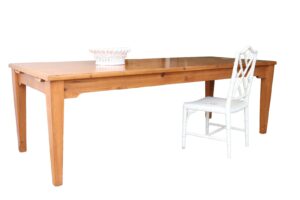
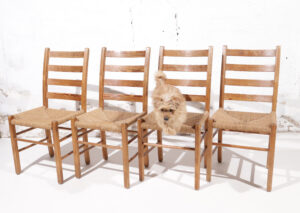
1950 Extra large pine farmhouse table € 275 1965 Set of 4 Scandinavian pine ladder-back chairs with seagrass seats € 545Postmodern
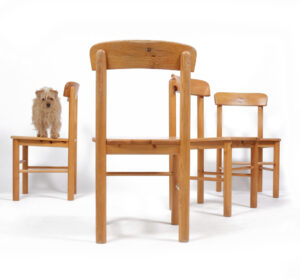
1970 Set of four sculptural pine dining chairs € 195 1975 Set of 4 Danish pine chairs in Rainer Daumiller style € 5955 pieces in pine found a new home


Looking for something in pine?
Let us know. We buy every week and will tell you when something comes in. We ship worldwide.