

Rattan is the stem of a climbing palm from the tropics. It is light, tough and flexible, and you can make a whole chair frame from it as well as the fine weave of a seat. That is why you come across it everywhere: in the Viennese café chair, in the conservatory chairs of around 1900 and in the light armchairs of the 1950s and 1960s. What the Dutch call a rieten stoel, a reed chair, is almost always made of rattan.
What it is
Rattan is the name for about six hundred species of climbing palms from the Old World. The largest genus is called Calamus. The plants grow in tropical rainforests, mostly in South-East Asia; about seventy per cent of all rattan grows in Indonesia. The word comes from Malay: rotan.
A rattan palm does not form a trunk as a tree does. It climbs up through other trees with long, thin stems. Those stems are a few millimetres to almost ten centimetres thick and grow tens of metres long, some up to two hundred metres. They stay the same thickness along their whole length. And they are solid: unlike bamboo, rattan is not hollow inside.
Two materials from one stem
The whole stem, cleaned and dried, serves as a frame. Over a flame it can be bent by hand. The stem is also split into two parts, each with its own job.
The hard outer layer is cut into narrow strips. These are used to wrap joints, and from them the familiar open mesh is woven that you see in chair seats and backs. In the trade that weave is called cane webbing or Viennese cane. The core of the stem is cut into round strands of different thicknesses. That is centre cane, pitriet in Dutch, the softer material of baskets and of closely woven chairs.
Reed, bamboo and willow
Around 1880 rattan came to be called riet, reed, in the Netherlands, because the stem looked like that of common reed. True reed, Phragmites australis, is a grass with a hollow stem and something quite different. So a reed chair is seldom made of reed.
Bamboo is a grass too. The stem is hollow and has nodes. Cleaned rattan looks like it at first glance, but is solid. Willow rods are the shoots of the willow, the material with which weaving began in Noordwolde. Rattan stays the same thickness along its whole length, is more supple than willow and lasts longer.
The history in furniture
The open-mesh pattern became popular in Vienna in the eighteenth century and has been called Wiener Geflecht ever since. Michael Thonet used it for the seat of his chair No. 14 of 1859, the best-known café chair in the world. From about 1880 whole pieces of furniture in rattan came into fashion, first for the garden and the conservatory and then for the living room. In the nineteenth century people also considered woven furniture cleaner than upholstered furniture.
The modern designers took it up. In 1928 Marcel Breuer set a seat and back of rattan in a frame of tubular steel; that chair later became known as the Cesca. The Italian architect Franco Albini (1905–1977) drew the Margherita armchair in 1951, built up from sixty rattan canes, which won a gold medal at the ninth Milan Triennale. The Dane Poul Kjærholm combined steel and woven rattan in his PK24 chaise longue of 1965.
Noordwolde and Dirk van Sliedregt
In the Netherlands its cradle is Noordwolde, a village in the province of Friesland. Two factories there, Rohé and Gebr. Jonkers, specialised in wickerwork. The rattan came from Indonesia and replaced the willow rods with which the village had begun. Both factories worked with Danish and Dutch designers, among them Dirk van Sliedregt.
Van Sliedregt first drew a chair made entirely of rattan. In the early 1950s he came up with the combination of rattan and a frame of tubular steel. It was a great success, praised by the Stichting Goed Wonen, the Dutch foundation for good living. The Rohé chair 149 is now the showpiece of the Nationaal Vlechtmuseum, the Dutch national wickerwork museum, in Noordwolde. You can read the whole story of the village and the factory in the book on Rohé Noordwolde.
In the 1970s rattan came back into fashion, this time together with bamboo. The Milanese designer Gabriella Crespi made a whole collection in those two materials between 1972 and 1975.
How to recognise it
Look at the end of a stem, under a leg or at the back. There rattan is dense and full, with no hollow. The stem is round, smooth and the same thickness along its whole length. Real rattan is light: you can lift an armchair with one hand.
In cane webbing you see narrow, flat strips, woven into an open mesh. Centre cane is round and the same thickness throughout. If you see a hollow stem with nodes, it is bamboo. If you see rods that grow thinner towards one end, it is willow.
What to look for when you buy
Sit in it and listen. A little creaking is to be expected, but the frame must not wobble. Look at the wrapped joints: that is where the binding comes loose first. Check that the spindles are whole and that no stem has broken at the point where it is bent most sharply.
With cane webbing, look for broken strands and for a seat that sags. A mesh with a hole in it will tear further. On chairs with a steel frame, look for rust under the legs and look at the caps. Finally, check that the weave is nowhere dry and cracked.
Care in brief
Rattan does not like dry, hot air, or being left wet. Do not put it against a radiator or in full sun, and dust it with a soft brush. There is more in the book Caring for rattan and cane on the Care shelf.
Why we love it
Rattan is light in every sense. You look through it, it casts a fine shadow on the wall and it leaves a room open. Beside dark wood or a heavy cabinet it brings air. The colour is warm and matt, and only grows more beautiful with the years. You will find the rattan pieces from our collection below, and every one of them already has a life behind it. We ship worldwide.
Written by De HuiszwaluwRattan
Mid-century
Postmodern

Contemporary
Timeless
Mid-century
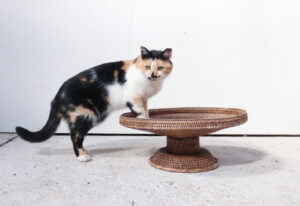
1950 Wicker fruit bowl on foot € 65Postmodern
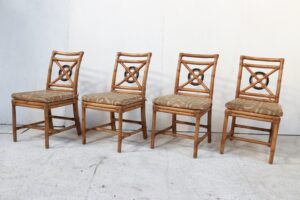
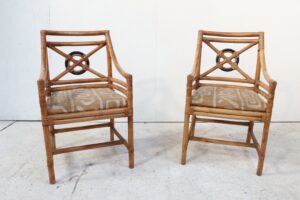
1975 Set of 4 rattan dining chairs with Target back € 345 1975 Pair of rattan armchairs with Target back € 395 1975 French freestanding rattan bar from the 1970s € 1.095Contemporary
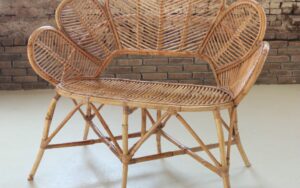
2010 Rattan bench with petal-shaped back € 100Timeless
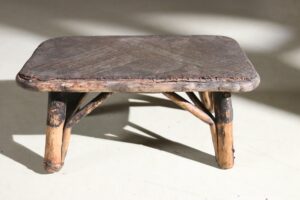
Small Old Bamboo Footstool with Leather Top € 13524 pieces in rattan found a new home
 Set of 4 Dirk Van Sliedregt Rattan Chairs Black Legs Rohe NoordwoldeSold
 Charlotte Perriand Style Rattan Bar Stool Dirk Van Sliedregt 1960sSold
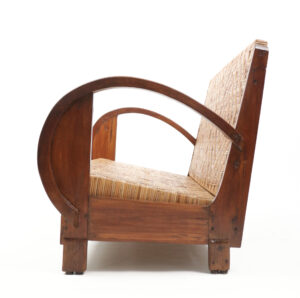 British Colonial Rattan and Wood Art Deco Lounge Sofa c. 1920sSold
 Vintage Design Rattan Side Table Rohé Dirk van SliedregtSold
 Boho Rattan Newspaper Table, Ice Glass, 1960sSold
 Vintage Dutch Design Rohe Rattan Lounge Chair with Sheepskin, 1960s, No. 2Sold
 Vintage Dutch Design Rohe Rattan Lounge Chair with Sheepskin, 1960sSold
 Vintage Design Rattan Side Table Rohe Dirk van SliedregtSold
 Vintage Design High Side Table, Metal, Wood and RattanSold
 Vintage Design Rohe Rattan Snake Plant Holder, 1960sSold
 Vintage Design Franco Albini Style Rattan Rocking Chair, 1960sSold
 Retro Vintage Rattan Armchair, 1950s, No. 2Sold
 Retro Vintage Rattan Side Table, 1950sSold
 Retro Vintage Rattan Armchair, 1950s, No. 1Sold
 Generous Retro Vintage Rattan Armchair, American StyleSold
 Retro Vintage Rattan Rocking Chair, 1960sSold
 Retro Vintage Rohe Noordwolde Rattan and Metal Armchair, 1960sSold
 Retro Vintage Rattan Side Table, 1960s, Fine ConditionSold
 Retro Vintage Round Rattan Coffee Table or Side Table 1960sSold
 Retro Vintage Rattan Coffee Table 1960sSold
 Retro Vintage Rattan DaybedSold
 Retro Vintage Rattan and Wooden Side Table 1950sSold
 Retro Vintage Rohe Armchair Rattan 1960sSold
 Retro Vintage Rohe Rattan Armchair and Coffee TableSold
Looking for something in rattan?
Let us know. We buy every week and will tell you when something comes in. We ship worldwide.