

Rosewood is the darkest and richest wood of the 1960s. Deep brown with black veins, sometimes with a purple glow: no two tops are alike. You find it on Danish sideboards, dining tables and desks, and on the shells of famous chairs. It is also a wood where you as a buyer need to pay attention to paperwork. A large part of this book is about that.
What rosewood is
Rosewood is the wood of trees of the genus Dalbergia, in the pea family. In Dutch it is called palissander; the English name rosewood comes from the sweet smell of roses it gives off when it is worked. Of the many species of Dalbergia only about a dozen yield true rosewood. In furniture it is almost always one of two.
Rio rosewood, also called Brazilian rosewood, is Dalbergia nigra. The tree grows only in the Atlantic Forest of south-eastern Brazil, in the states of Bahia, Espírito Santo, Minas Gerais and Rio de Janeiro, and reaches 30 to 40 metres. The wood is chocolate brown to purplish or reddish brown, with dark streaks. Those black veins sometimes form a figure like a spider’s web or a landscape. Dried, it weighs about 835 kilos per cubic metre.
Indian rosewood is Dalbergia latifolia, from India, Sri Lanka and Indonesia. It is golden brown to deep purplish brown with dark streaks and turns deep brown over the years. It is just as heavy, about 855 kilos per cubic metre.
Its history in furniture
Rio rosewood was already prized in the English Regency, in the late eighteenth and early nineteenth centuries. Because the figure is so strong, the wood was often cut into veneer: for furniture, for wall panelling and for piano cases.
Its second flowering came with Danish furniture. Arne Vodder (1926–2009) worked mainly in rosewood and teak. From the 1950s he designed for the manufacturer Sibast. His rosewood sideboard with drawers shaped so that handles are not needed is well known. Ejner Larsen (1917–1987) and Aksel Bender Madsen (1916–2000) worked together mainly in teak and rosewood, and Ole Wanscher had his Colonial Chair made in Rio rosewood. In America the Lounge Chair by Charles and Ray Eames of 1956 was given shells veneered in Rio rosewood.
Most of the rosewood furniture you come across today dates from the 1950s and 1960s. In the sideboards, dining tables and wall units of those years it is almost always veneer on a board core, with solid edges and legs.
Rio or Indian, mahogany or stain
Rio and Indian rosewood are often confused. Rio can have the wild black veins known as spider-webbing; Indian rosewood is often more purple in tone. That does not tell you for certain. The most reliable difference lies in the pores on the end grain: Rio rosewood has about half as many as Indian.
Mahogany is a different wood. It is pale pinkish brown to reddish brown, darkens over the years and has a soft sheen that shifts as you walk past. It has no black veins. It is also much lighter: about 590 kilos per cubic metre.
Then there is wood stained in a rosewood colour. A cheaper timber was given a dark brown stain, sometimes with black streaks painted into it. From a distance it looks the part; close up it does not.
How to recognise rosewood
Real rosewood has depth. The dark veins run irregularly, jump about and sit in the wood, not on it. You see open pores as fine little lines. The wood is heavy and hard.
In stained wood the colour sits at the surface. Look for a scratch or a worn edge: if pale wood shows underneath, it is stain. Look on the inside of a door or under the top as well. If the wood there is pale and has a different grain, only the outside has been coloured. Painted streaks are too regular and stop at an edge instead of running over it.
You recognise veneer at the edge of a top: there you see a thin layer on a different base, or a glued-on solid lipping. The veneer is often laid as a mirror image, so that the same figure returns to the left and right of a joint.
What to look for when you buy a piece
Check the edges and corners for veneer that is lifting or missing. Look across the top against the light: you then see bumps, rings and places that have been touched up. Wood changes colour in the light: compare the top with the sides and with a spot where something has stood for a long time. And always ask about the paperwork.
Rio rosewood and CITES: what the rules say
Rio rosewood (Dalbergia nigra) has been on Appendix I of CITES, the convention on trade in endangered species, since 11 June 1992. That is the strictest category. In the European Union the species is on Annex A. What follows is what is written about it by RVO, the Netherlands Enterprise Agency, which issues the CITES documents in the Netherlands.
For a sale within the EU an EU certificate is required. RVO issues one only if the wood was already in the EU before 11 June 1992 and if it can be shown that it was legally bought or acquired, for example with an earlier certificate, a proof of purchase or an entry in a catalogue. A 1960s piece in Rio rosewood should therefore be sold with an EU certificate.
There is one exception. An object made before 3 March 1947 counts as an antique. It may be traded within the EU without a certificate, provided it entered the EU legally and its age can be demonstrated.
For shipping to a country outside the EU, CITES documents are always required, for antiques too: an export permit from RVO and an import permit from the country of destination. Before you buy, ask the authority in your own country what applies there.
And Indian rosewood
All other species of Dalbergia, Indian rosewood included, have been on Appendix II of CITES since 2 January 2017 and on Annex B in the EU. That is lighter. According to RVO no import or export permit is needed for finished products containing no more than 10 kilos of this wood per shipment. If there is more, a permit is needed for shipping outside the EU. Within the EU you must be able to show that the piece was legally bought or acquired. If you can, an EU certificate is not needed.
Care in brief
Dust with a dry, soft cloth. Do not stand a rosewood piece in full sun and do not leave water on it. You can read more about oil, wax and old lacquer in the book Caring for wood on the Care shelf.
Why we love it
Rosewood gives a light room a dark, quiet focal point. Against a limewashed wall a sideboard almost becomes a painting: you keep looking at the veins. The wood is matt and deep, never loud. And there will be no new Rio rosewood. What there is, is what there is, and that makes every well-kept piece something to treasure.
You will find the rosewood pieces from our collection below. Every one of them already has a life behind it. We ship worldwide.
Written by De HuiszwaluwRosewood
Postmodern
58 pieces in rosewood found a new home
 Vintage rosewood extending dining table 1960sSold
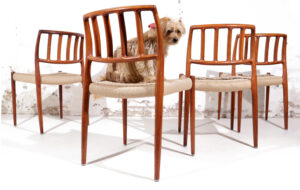
 4 Danish design rosewood chairsSold
 Early 19th Century Rosewood Game, Card TableSold
 Vintage Design Nesting Tables Mimiset Rosewood ChromeSold
 Mid-Century Design Chair Rosewood Black Faux Leather 1960sSold
 Set of 6 Mid-century Design Niels Møller Model 78 Rosewood Dining ChairsSold
 Danish Rosewood Mid-Century Dining Chairs Johannes Andersen Christian LinnebergSold
 Johannes Andersen Rosewood Dining Table Christian Linneberg Denmark 1964Sold
 Vintage Sleek Long Sideboard, Rosewood / BlackSold
 Danish Design Rosewood Tea Trolley, Mid-CenturySold
 TOP! Sleek Vintage Design Long and Low Rosewood Sideboard, 1960sSold
 TOP! Sleek Vintage Design Rosewood Sideboard, 1960sSold
 Vintage Design Oval Rosewood Coffee Table, 1960sSold
 TOP! Vintage Design Sleek Rosewood SideboardSold
 Vintage Design Topform Rosewood Coffee Table, 1960sSold
 Vintage design highboard sideboard rosewood Fristho no. IISold
 Vintage design highboard sideboard rosewood FristhoSold
 TOP Vintage Design Rosewood Danish Coffee Table, 1960sSold
 Great Vintage Design Sofa, Bi-Colour, Rosewood, 1960sSold
 Special Vintage Design Dining Table, Rosewood and White PanelSold
 Vintage Design Rosewood Extending Table, 1960sSold
 Vintage Design Rosewood and White Display Cabinet Inmobel, 1960sSold
 Vintage Design Rosewood / White Wall Unit Inmobel, 1960sSold
 TOP! Rosewood Vintage Design Display Sideboard, 1960sSold
Looking for something in rosewood?
Let us know. We buy every week and will tell you when something comes in. We ship worldwide.